

One or more Worker Nodes run applications and a Control Plane (Master) makes decisions under Kubernetes client-server approach.
The Control Plane (Master)
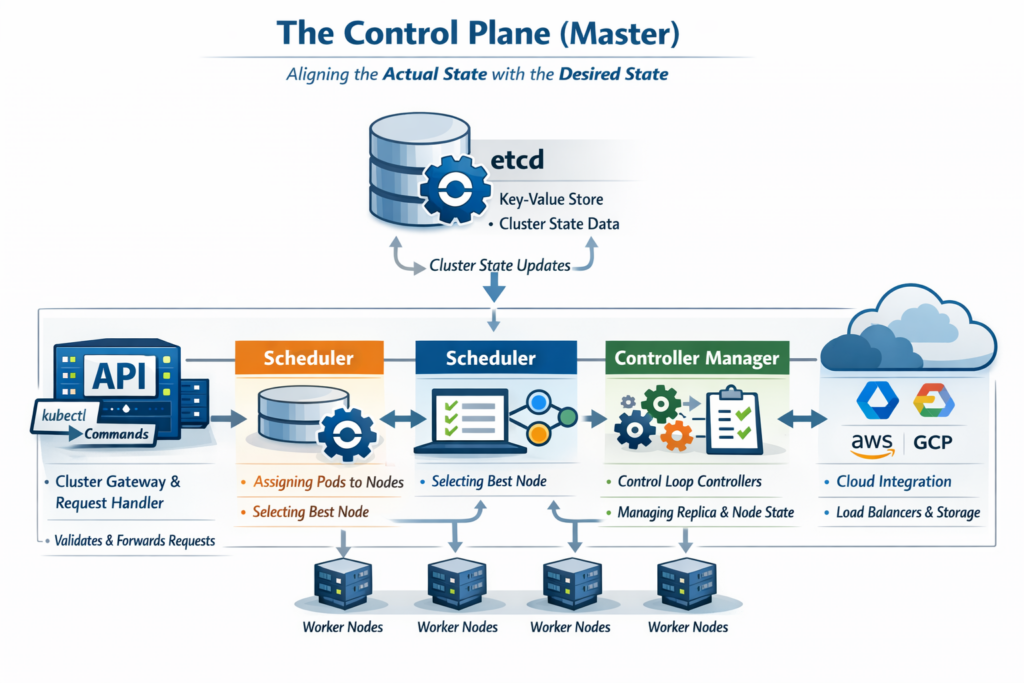
As the “brains” of the cluster, the Control Plane keeps track of its objects and works nonstop to align the “actual state” and “desired state” of the system.
- API Server (
kube-apiserver): The Control Plane’s front-end interface is the API Server (kube-apiserver). This gateway is used for all internal and external communications, including orders fromkubectl. A Kubernetes control plane component, the API server exposes the API. It listens for Kubectl-style CLI changes and queries as a cluster gateway. When something needs to be done, such adding or removing pods, Kubectl talks with the API Server. It also functions as a gatekeeper. After receiving a request, it usually verifies it before sending it on to other processes. The API Server must be used before any request can be sent directly to the cluster. - Etcd: Etcd is a cluster’s key-value store. Changes to the Cluster State are saved in the etcd. Because it informs the Scheduler and other processes about available resources and changes in the cluster’s state, it functions as the cluster brain.
- Scheduler (
kube-scheduler): In charge of allocating the workload (kube-scheduler). The API server alerts it to new Pods and it chooses the best worker node based on resources and limitations. - Controller Manager (
kube-controller-manager): It runs the cluster’s control loop controllers. These controllers include the node controller, which makes sure that nodes are appropriately identified as “ready” or “not ready” according on their present condition, and the replication controller, which guarantees that the required number of replicas of a certain application are operating. - Cloud Controller Manager: An optional part that controls integration with particular cloud service providers (such as AWS or GCP) to manage load balancers, virtual networking, and storage.
You can also read What is Container Orchestration in Kubernetes?
Worker Nodes
Worker nodes are virtual or physical devices that are specifically designed to run your containerized apps.
- Kubelet: Each node’s main agent is called Kubelet. Each Kubernetes node has a kubelet agent. It coordinates with the container runtime and Kubernetes control plane to ensure pod containers run as intended. The kubelet monitors pods, reports node and pod status to the API server, and maintains container settings.
- Kube-proxy: Each node runs the Kube-proxy, which oversees network connections for pods. By upholding network rules that enable pods to connect with one another and with external clients, it implements Kubernetes Services. Kube-proxy handles traffic via iptables or IPVS, providing pod-wide service discovery and load balancing.
- Container Runtime: A container runtime is the software that runs containers on a node. It runs pod application containers and maintains their lifecycle. Container runtimes like Docker, containerd, and CRI-O are popular.
Core Building Blocks
- Pod: A pod is Kubernetes’ smallest unit. Encapsulates one or more containers with the same network namespace and storage.
- Service: An abstraction that gives users access to a dynamic set of Pods via a reliable, long-term network endpoint (IP address and DNS name).
- Deployment: A resource that supports rolling updates and rollbacks, maintains replicated Pods, and gives apps declarative updates.
- Namespace: A virtual cluster that allocates resources to various users, groups, or initiatives.
You can also read What is the Importance of Kubernetes & Why Kubernetes?
Is Kubernetes control plane the same as master?
Modern Kubernetes Control Plane and Master are similar but distinct. The node running core management components was called “Master” in previous versions. Today, “Control Plane” better describes the API server, scheduler, and controller manager that govern the cluster’s state. Although sometimes used colloquially, “Master” is archaic. In summary, the Control Plane replaces and expands Kubernetes’ Master.
What is the difference between Kubernetes API and control plane?
The Kubernetes Control Plane manages the cluster’s state. It has API server, scheduler, and controller manager. Kubernetes API is the API server’s interface for users and systems to communicate with the cluster. The API is the “gateway” for interaction, whereas the Control Plane is the “brain” that evaluates requests and makes decisions. Thus, the API is Control Plane-integrated.
What is the purpose of the Kubernetes control plane?
Kubernetes’ control plane controls all cluster operations. Its major goal is to keep the system running smoothly and ensure apps work properly. It manages workload scheduling, cluster health, and scalability and failures. The API server, scheduler, and controller manager process user requests, make decisions, and enforce policies. The control plane assures cluster dependability, consistency, and resource efficiency by continuously reconciling the actual state with the desired state.