

JavaScript Fundamentals for Node.js
Node.js lets developers write front-end and back-end code in JavaScript, which reduces context-switching and simplifies library sharing. JavaScript fundamentals should be understood before getting into Node.js.
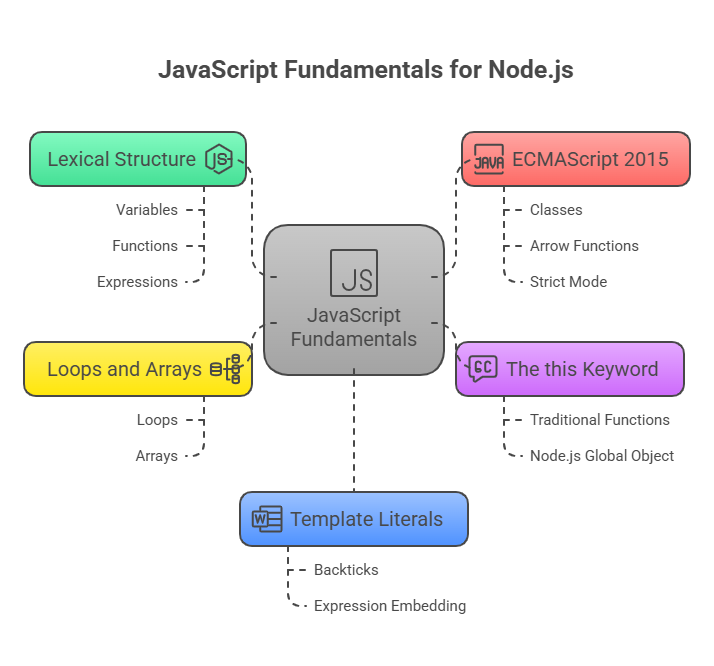
These are some basic ideas:
- Lexical Structure, Expressions, Types, Variables, and Functions: These are the basic building blocks of any JavaScript program.
- Variables are used to store values. Before ES6 (ECMAScript 2015),
varwas the primary keyword for declaring variables, allowing them to be re-declared and updated. With ES6,constandletwere introduced, offering block-scoped variables, unlikevarwhich is bound to function scope.constdeclares real constants that cannot be reassigned once set. - Functions are first-class citizens in JavaScript, meaning they can be passed as arguments, returned from other functions, and assigned to variables.
- Expressions are pieces of code that produce a value.
- Variables are used to store values. Before ES6 (ECMAScript 2015),
- The this Keyword: Understanding
thisis vital. In traditional JavaScript functions,thisrefers to the instance object used to call that function. However, its binding can be unpredictable depending on how the function is called. In Node.js,globalis the global object, similar towindowin a browser environment. - For example, in a traditional function defined at the global scope,
thismight refer to theglobalobject in Node.js. - Loops and Arrays: Iteration requires loops (
for,while,forEach, etc.). Data collections in order are called arrays. Libraries likelodashoffer array filtering, sorting, and manipulation capabilities. - Template Literals (Template Strings): ES6 introduced Template Literals (Template Strings) for easier concatenation of strings and variables using backticks (
`) and${}for expression embedding. This is much simpler to comprehend and update than string concatenation. - ECMAScript 2015 (ES6) and Beyond: Node.js is designed against current V8 engines, ensuring timely access to new JavaScript ECMA-262 features. Many ES6 features are supported by Node.js. Classes, arrow functions, rest parameters, and default function parameters are some examples of these features. The ‘
use strict‘ command activates thestrictmode, which is crucial for utilising contemporary JavaScript features like classes.
Function Declarations vs. Function Expressions
JavaScript has two main methods for defining functions, each with unique characteristics, particularly when it comes to hoisting (the ability to utilise a function before it is defined in the code) and how this is constrained. JavaScript frequently uses this pattern.
Function Declarations
- These are “normal functions we write”.
- They are defined using the
functionkeyword, followed by a name, parameters, and a function body. - Crucially, function declarations are hoisted: This means they are loaded into memory before the code execution begins, allowing them to be called before their actual declaration in the script.
Function Expressions
- A function expression is created when the
functionkeyword is used to define a function inside an expression. This means the function is often assigned to a variable. - Function expressions are not hoisted in the same way as declarations: They behave like other variable assignments, meaning they are only available after that line of code has been executed.
Arrow Functions (=>) as a Common Function Expression
- With ES6, arrow functions became a popular shorthand syntax for writing function expressions. They are particularly useful for functions that immediately return a value.
- Key Difference with this in Arrow Functions: One of the most significant differences between arrow functions and traditional functions (both declarations and expressions) is how they handle the
thiskeyword. Arrow functions do not bind their own this value; instead, they lexically inherit this from the enclosing scope where they are defined. This makes them very predictable and often preferred in modern JavaScript, especially within object methods or callbacks. - If you were to use a traditional
functionexpression inside theforEachloop in the example above,thiswould not refer to theeventobject, leading toundefinedforthis.nameinside that callback. This is why arrow functions are often preferred for callbacks and nested functions where preserving thethiscontext from the outer scope is desired. - Another point is that arrow functions do not bind the
argumentsarray.
In conclusion
A solid understanding of these JavaScript fundamentals, especially the nuances of this and the different function syntaxes (declarations, expressions, and arrow functions), will significantly enhance your ability to write efficient and maintainable Node.js applications.