

We covered Linux vs Other Operating Systems, difference between Linux and Windows, and the Open-Source Philosophy in this blog.
Linux vs Other Operating Systems
Windows, macOS, and Linux are much discussed operating systems. They all supported computer operation and program execution, although their designs differed. Knowing these distinctions makes it evident why Linux is unique in the modern era.
Control and Ownership
- A major difference between Linux and other operating systems is program control.
- Linux is open-source. This signifies public access to the source code. Anyone can study, change, and share it. Thus, no company owns Linux. It is maintained by a global network of companies and developers.
- MacOS and Windows are proprietary. Users depend on the company that made them for features, upgrades, and fixes as their source code is closed. Although you are subject to some licence conditions when using the system, you have little actual control over its design.
- Linux users now have more freedom because to this distinction, particularly in technical and professional settings.
Alos Read About What Is Linux? A Brief History And Evolution Of Linux
Expense and Permissions
- Linux is usually free. Linux distros are free to download, install, and use. Even the most sophisticated server versions are frequently free or far less expensive than their proprietary counterparts.
- Typically, Windows and macOS are not free. It is necessary to purchase Windows licenses, particularly for server or corporate editions. Only when purchased with Apple hardware which is pricey in and of itself is macOS free.
- Linux is so commonly used in research labs, education, startups, and developing areas where cost is a factor.
Utilization of Resources and Performance
- Linux is portable and efficient. It supports old systems, high-performance servers, and low-power devices. Users can run Linux without a GUI or use minimalist desktop settings.
- Linux is perfect for servers, embedded systems, and cloud platforms because of its efficiency.
Consistency and Dependability
- Long uptime is a well-known feature of Linux systems. Many Linux systems don’t need restarts for months or years. Stability is crucial in dangerous or expensive downtime situations.
- After updates, some operating systems may need repeated reboots. This can be an issue in enterprise and mission-critical systems, but it is acceptable for consumer PCs.
- Linux is widely used in web servers and data centres due of its dependability.
Security Model
- Linux rigorously follows permission-based security. User and program access is restricted by default, reducing the risk of inadvertent harm or malware spread. Security updates often arrive quickly and can be installed without restarting the system.
- Due to their widespread desktop use, malware still targets Windows and macOS more often despite security improvements. Linux’s design and transparency are advantageous since flaws are publicly examined and addressed.
- Linux is a great option for security systems because of this.
Customization and Software
- Linux provides a great deal of personalisation. Users can change the desktop, system behaviour, services, and kernel. Several Linux distributions meet different needs.
- Other operating systems prioritise user experience and consistency. Windows and macOS offer minimal customisation to guarantee consistent system behaviour.
- Linux is obviously different for users who prefer flexibility and control.
Use Cases and Industry Adoption
Linux is the industry leader in:
- Web servers
- Cloud computing
- Supercomputers
- Networking devices
- Embedded systems
- Android smartphones
Windows is more common in:
- Workplace settings
- Playing games
- Home users in general
macOS is well-liked by:
- Professionals in creativity
- The Apple ecosystem’s developers
Linux’s widespread industry adoption demonstrates its significance outside of desktop computers.
Learning and Skill Development
Linux is frequently utilised in jobs related to cloud computing, networking, cybersecurity, and IT. Learning Linux entails gaining knowledge that is immediately applicable to systems in the real world.
Although many core processes are hidden, some operating systems are simpler for casual use. Linux is useful for both experts and students since it reveals how systems actually operate.
Also Read About Linux Architecture Layers: Kernel, Shell, And Hardware
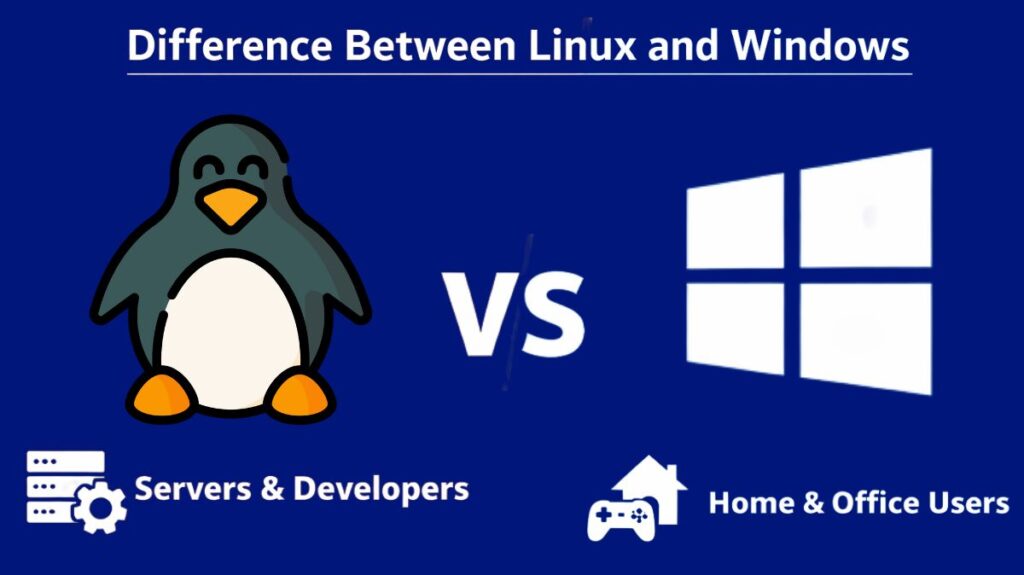
Difference Between Linux and Windows
| Aspect | Linux | Windows |
|---|---|---|
| Ownership | Open-source and community-driven | Proprietary and owned by Microsoft |
| Cost | Free to use in most cases | Requires a paid license |
| Customization | Highly customizable at almost every level | Limited customization |
| Security | Strong permission system, fewer malware attacks | More frequently targeted by malware |
| Stability | Can run for long periods without reboot | Often needs restarts after updates |
| Performance | Works well even on older or low-spec systems | Requires comparatively higher resources |
| Software Installation | Uses package managers (apt, dnf, etc.) | Uses executable installers (.exe, .msi) |
| User Interface | Many desktop environments available | Single main interface style |
| Hardware Support | Very good for servers and embedded systems | Excellent support for consumer hardware |
| Gaming Support | Improving, but still limited compared to Windows | Best support for modern games |
| Learning Curve | Steeper for beginners | Easier for new users |
| Usage Areas | Servers, cloud, cybersecurity, development | Home, office, gaming |
Choose Linux If
- You want a free, open-source OS.
- You want to know how systems work.
- You deal with cloud computing, servers, or cybersecurity.
- On older hardware, you need higher performance.
- You like control and personalisation.
- Stability and extended system uptime are important to you.
Choose Windows If
- You immediately want an operating system that is simple to use.
- You primarily use your computer for general tasks or office work.
- You engage in contemporary PC gaming.
- You use proprietary software that is limited to Windows.
- You favour robust plug-and-play hardware compatibility.
- Command-line tools are not something you want to deal with.
A Brief Conclusion
For people who appreciate flexibility, control, and learning, Linux is perfect.
For consumers who want gaming, broad program support, and simplicity, Windows is superior.
Also Read About How Linux Works And Why Linux Is Important For Developers
Open-Source Philosophy
The fundamental tenet of the open-source movement is that software ought to be accessible for anyone to view, learn from, and enhance. Open source permits the code of a program to be shared publicly rather than concealing its inner workings. This concept has revolutionised software development and contributed significantly to the popularity of systems like Linux.
Core Idea of Open Source
Open source is really about transparency and freedom. Users are not compelled to blindly trust a firm when software is open source. They are able to observe the software in action. The community can make improvements if something appears to be flawed. This method views consumers as more than simply clients they are contributors.
Sharing Knowledge Instead of Locking It
The code of traditional software is frequently kept hidden. Open source adopts a different approach. It holds that everyone may develop by exchanging knowledge. When developers share their work, others can use it for new purposes, make improvements, or learn from it. Better and more dependable software is eventually produced as a result of this sharing.
Community and Collaboration
Communities create open-source projects. Students, professionals, researchers, and businesses make up these communities. Individuals contribute in a variety of ways; some develop code, others identify issues, and still others enhance documentation. Problems can be resolved more quickly and ideas can keep getting better because to this teamwork. Because no one individual has complete control, the software is more robust.
Transparency and Trust
Open-source software is transparent due to its open source code. Because there is nothing hidden, users may have faith in the system. Particularly in areas like security and privacy, this transparency is crucial. Errors and vulnerabilities are more likely to be discovered and fixed when thousands of people review the same code.
Freedom to Modify Software
The freedom to alter software is a key component of the open-source ideology. Programs can be switched by users to suit their own requirements. They are not required to wait for formal authorisations or upgrades. One reason open-source software is so popular in servers, research, and large-scale systems is its flexibility.
Cost and Accessibility
The majority of open-source software is available for free. This enables students, startups, and low-budget organisations to have access to advanced technology. Without having to worry about paying for a licence, people can experiment and learn. Globally, this accessibility promotes creativity and skill development.
Open Source in Everyday Technology
Open-source software is widely used nowadays. Supercomputers, servers, cloud platforms, and smartphones are all powered by Linux. A lot of online technologies and programming tools are also open source. This demonstrates that the open-source concept is effective in practical systems as well as theory.
Also Read About What is a Network Server, How it Works, Types and Components