

We talked about what Linux is in this blog. A brief history and evolution of Linux.
What Is Linux?
Linux is a powerful, open-source operating system that forms the backbone of much of today’s digital world. An operating system (OS) is the core software that manages computer hardware and software resources while providing essential services to users and applications. Linux stands apart from many other operating systems because it is freely available, highly customizable, secure, and developed collaboratively by a global community.
Linux was first developed as a side project by Linus Torvalds in 1991 with the goal of creating a free substitute for proprietary UNIX systems. It developed over time into a sophisticated, business-grade operating system that is utilised by supercomputers, servers, desktop computers, mobile devices, and embedded systems. Linux now powers web servers, cellphones, cloud platforms, scientific research systems, and vital infrastructure all around the world.
History And Evolution Of Linux
Overview
One of the most popular and significant operating systems ever created is Linux. Linux is special because of its ideology as well as its technological prowess. In contrast to proprietary operating systems developed by individual businesses, Linux expanded through international cooperation. Its growth demonstrates how a basic concept may become the cornerstone of contemporary computing through free knowledge and collaborative development.
The Foundations: UNIX and MINIX
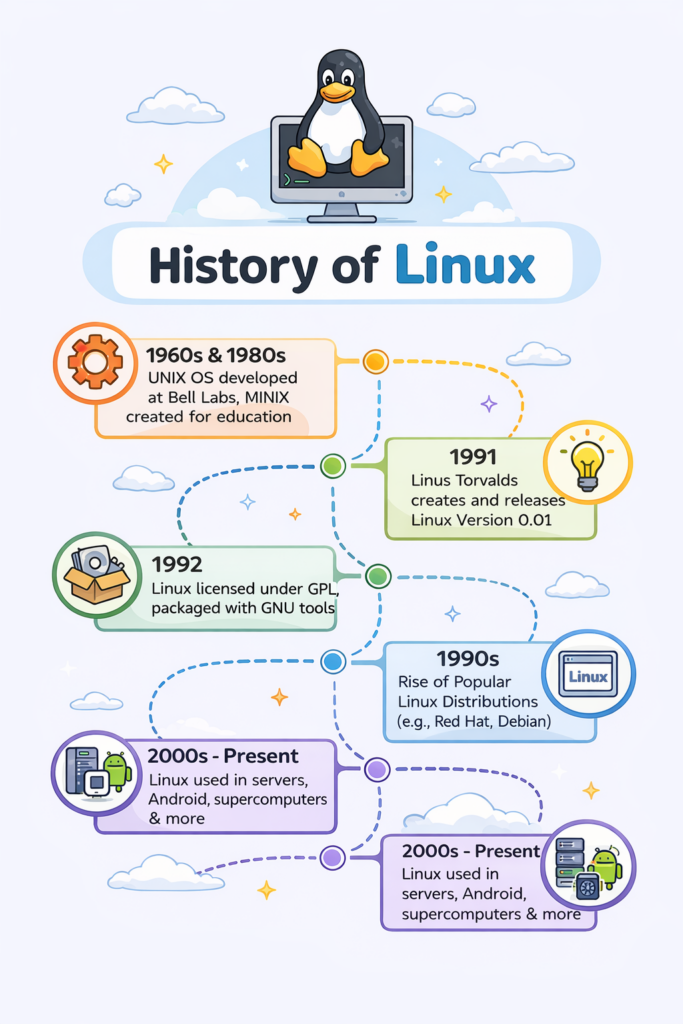
UNIX, an operating system created at AT&T’s Bell Labs in the late 1960s, is where Linux got its start. Although UNIX introduced innovative ideas like multitasking and a hierarchical file system, many people were unable to use it due to its high cost and proprietary nature. Andrew S. Tanenbaum developed MINIX for educational purposes in the 1980s, but users were unable to freely alter it due to license constraints. Linus Torvalds, a student of computer science, was inspired by this loss of freedom to develop a free substitute.
Early Development and Birth (1991)
Torvalds famously described his project as “just a hobby, not big and professional” when he debuted it on an internet forum in August 1991 while he was a student at the University of Helsinki. In September 1991, he published the initial version of the Linux kernel (0.01), which was created especially to operate on Intel-powered personal computers. Torvalds made the source code publicly available so that developers from all around the world could contribute and enhance it, despite the fact that it was initially simple and hardware-limited.
Linux/GNU Synergy
The 1983 merger of Linux with Richard Stallman’s GNU Project was a turning point in the company’s history. The GNU Project lacked a functional kernel, while having created necessary tools including compilers, shells, and libraries. Linux supplied the kernel that was lacking, and together they created a full operating system that is frequently referred to as GNU/Linux. Linux made sure it would continue to be free and open-source by embracing the GNU General Public License (GPL), which spurred quick expansion and transparency.
Commercialization and Growth (1992–2010)
Through community cooperation, the system developed file systems and received networking support during the 1990s. Linux versions like Slackware and Debian, which bundled the kernel with apps to make it easier to use, became popular at this time.
By the early 2000s, Linux has made its way into the business sector. During this decade, notable turning points included:
- Commercial Support: Businesses such as IBM, Oracle, and SUSE started offering expert Linux services.
- RHEL: Red Hat Enterprise Linux’s introduction demonstrated that open-source software could be a profitable business strategy.
- Infrastructure: Linux emerged as the industry standard for data centres and web servers.
The Contemporary Era (2010–Present)
The foundation of the global digital infrastructure today is Linux. Its impact is evident in a number of important areas:
- Mobile Technology: The Linux kernel serves as the foundation for the Android operating system, which runs billions of smartphones.
- Cloud and Supercomputing: All of the top supercomputers in the world are powered by Linux, which also rules platforms like AWS and Google Cloud.
- Emerging technology: It is essential to the advancement of quantum computing, the Internet of Things(IOT), and artificial intelligence (AI).
From a basic monolithic design, the Linux kernel has developed into a highly modular and scalable system that can support anything from large high-performance clusters to tiny embedded devices.
Evolution of the Linux Kernel
From a basic monolithic kernel, the Linux kernel has developed into a highly modular and scalable system. With time, it acquired:
- Better control over memory
- Sophisticated algorithms for scheduling
- Multiple architectures are supported.
- Improved security features
These days, Linux can run on everything from large high-performance servers to tiny embedded devices.
In conclusion
Linux’s evolution and history show how open cooperation can turn a modest concept into a major technological force on a worldwide scale. Linux has developed into a dependable, safe, and adaptable operating system that runs the contemporary digital world from its modest origins as a student project.
Linux’s history encompasses more than just software development; it is a philosophy of liberty, creativity, and collective advancement. Linux continues to be at the core of computing’s past, present, and future as technology advances.