

Linux has established itself as the main operating system for the “Quantum Era.” Linux serves as a link between conventional binary logic and quantum mechanics because quantum computers need enormous amounts of classical supercomputing capacity to do error correction and data pre-processing.

What is Linux Quantum Computing?
It is the process of programming, simulating, and controlling quantum processors (QPUs) using Linux-based infrastructure. Linux offers the classical control plane that controls the sensitive quantum state of qubits, not quantum computation.
Why is Linux Used for Quantum?
Open Source Frameworks: Nearly all of the main quantum SDKs, such as Cirq, PennyLane, and Qiskit, are Linux-native.
High-Performance Computing (HPC): Only the Linux kernel offers low-latency scheduling and memory management, which are necessary for quantum computers.
Scientific Libraries: The most sophisticated linear algebra and physics libraries (such as NumPy, SciPy, and BLAS) required to convert code into quantum gates are best supported by Linux.
Applications
- Creating new Linux kernel modules that employ “quantum-safe” encryption to stave against upcoming quantum attacks is known as post-quantum cryptography, or PQC.
- Quantum Chemistry: Drug discovery by molecular structure simulation (e.g., using the InQuanto platform on Linux).
- Optimization: Using D-Wave’s quantum annealing techniques to solve large logistical challenges (such as international shipping routes).
Essential Commands & Examples
Most quantum interaction happens via the Python CLI on Linux.
Checking for Quantum Keystore Vulnerabilities
As we enter the quantum age, standard encryption is at risk. Linux admins use tools to find “quantum-vulnerable” files:
Bash

# Search for RSA/DSA keys that are vulnerable to quantum decryption
sudo find / -type f \( -name "*.pem" -o -name "*.key" -o -name "*.p12" \) 2>/dev/null
Environment Management
Bash

# Create a dedicated quantum research environment
conda create -n quantum_lab python=3.11
conda activate quantum_lab

# Install the primary IBM Quantum SDK
pip install qiskit qiskit-aer qiskit-ibm-runtime
Simulation Benchmarking
Bash

# Monitor system resources while running a 40-qubit simulation
htop
# or check GPU utilization if using NVIDIA CUDA-Q
nvidia-smi
Setting Up the Environment
Step 1: System Preparation
Ensure your Linux headers and build tools are current, as some quantum simulators compile C++ code in the background.
Bash

sudo apt update && sudo apt install build-essential cmake git -y
Step 2: Install a Quantum SDK (Qiskit Example)
IBM’s Qiskit is the most popular choice for Linux users.
Bash

# In your virtual environment:
pip install qiskit[visualization]
Step 3: Configure Local Simulation
To test quantum code without a real quantum computer, install the Aer simulator:
Bash

pip install qiskit-aer
Step 4: Verify Installation
Run a simple 1-line Python check to see if your Linux system recognizes the quantum library:
Bash

python3 -c "import qiskit; print(qiskit.__version__)"
The Role of Linux in Quantum Computing
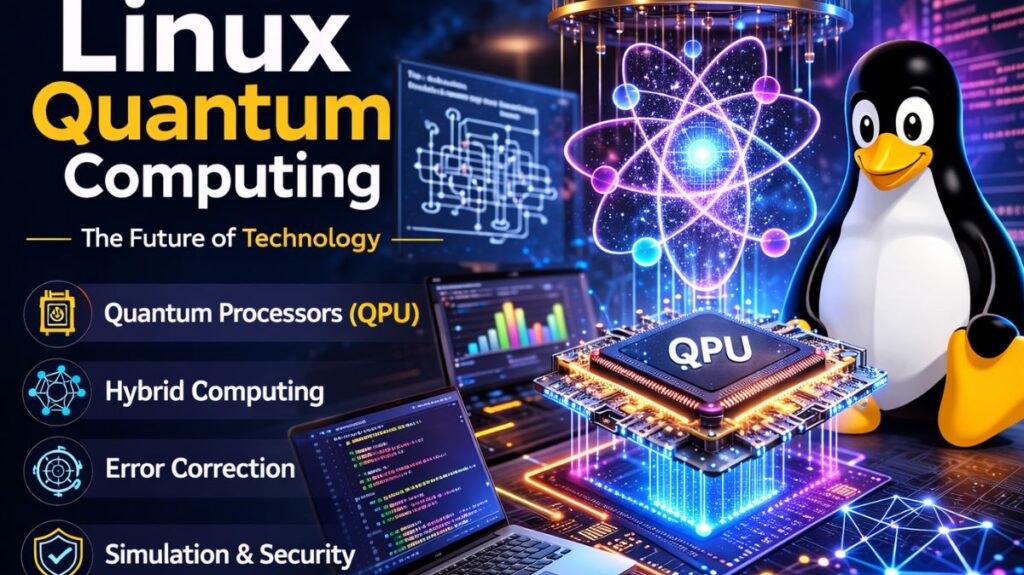
Hybrid Orchestration: The majority of quantum workloads are “hybrid,” in which a quantum processor is regularly called for complicated calculations by a Linux server running a classical algorithm.
Error Mitigation: The “noise” or errors that naturally arise in quantum qubits are calculated and corrected by Linux-based GPUs.
Simulation: Developers utilize Linux clusters to mimic quantum circuits prior to executing a program on an expensive quantum machine.
Best Linux distro for quantum computing
The “best” Linux distribution for quantum computing in 2026 will be determined by its capacity to perform hybrid classical-quantum workloads, in which your computer communicates with a quantum processor in the cloud while handling difficult arithmetic on a local GPU.
Ubuntu 24.04 LTS (The Industry Standard)
- Ideal For: The majority of students and researchers.
- Why: Ubuntu is used for the development and testing of nearly all quantum SDKs, such as Google’s Cirq and IBM’s Qiskit.
- Important Advantage: If you look for a solution to a “Quantum simulation error,” it is highly likely to be written for Ubuntu.
Pop!_OS (The GPU Powerhouse)
- Ideal For: Individuals conducting complex quantum simulations at home.
- Why: A GPU is needed for quantum simulation, which is basically fast matrix math.CUDA and NVIDIA drivers are pre-installed on the OS.
- The main advantage is that it keeps you out of “driver hell,” guaranteeing that your graphics card is prepared to mimic qubits as soon as the operating system is installed.
Fedora Scientific / Fedora AI (The Cutting Edge)
- Ideal For: Early-stage research and post-quantum cryptography (PQC).
- Why: Fedora maintains a Special Interest Group (SIG) just for Quantum. More quickly than any other stable distribution, it offers the most recent versions of Python and C++ compilers.
- The main advantage is that many of the math libraries required for quantum physics are pre-loaded in the “Scientific Lab” package.
Red Hat Enterprise Linux (RHEL) 10.0
- Ideal For: Supercomputing clusters and corporate labs.
- Why: You require enterprise-level security and complete stability when connecting to actual quantum hardware (QPUs).
- The main advantage is that RHEL is approved for the high-performance computing (HPC) hardware used in the “classical control” systems of physical quantum computers.
Quantum Tools for Your Distro
The most widely used Python-based SDK for creating quantum circuits is called Qiskit.
- Conda/Mamba: Essential for controlling “Quantum Environments” to prevent system libraries from interfering with physics libraries.
- Quantum researchers code and graph their experiments using JupyterLab, a common visual environment.
- Docker: Used to test new encryption techniques in “Quantum-Safe” containers without endangering your primary system.
Quantum computing in the Linux world
In 2026, the connection between Linux and quantum computing has transitioned from lab experiments to a real-world “hybrid” environment. Quantum computers are specialized accelerators that rely on Linux-based supercomputers to operate; they are not stand-alone devices.
The “Hybrid” Architecture
In essence, a quantum computer is a co-processor. The Quantum Processing Unit (QPU) manages the particular quantum gate operations in the modern data center, while a Linux-based classical server takes care of the user interface, data preparation, and error correction.
- Linux’s function is to serve as the “Control Plane.” It controls the fast feedback loops that reduce noise and calibrate qubits in real time.
- The Mosaic Effect: In order to overcome issues that no single chip can handle on its own, experts characterize 2026 computing as a “mosaic” in which CPUs, GPUs, and QPUs are closely interwoven into a single Linux environment.
Also read about Linux Security Features, Tools, And Why Linux Is Secure
The Rise of “Quantum OS” Layers
One of the first downloaded quantum operating systems, Origin Pilot, was introduced to the market at the beginning of 2026. These new layers handle the following, whereas classic Linux handles files and threads:
- Qubit Allocation: Linking the “logical qubits” in your code to the real qubits on the semiconductor.
- Error Mitigation Engines: Reducing the “noise” in quantum calculations by statistical methods.
- Managing the queue for thousands of people worldwide attempting to access a single quantum computer is the responsibility of job schedulers.
Post-Quantum Cryptography (PQC) in the Kernel
In 2026, protecting Linux from upcoming quantum attacks will be one of its most important responsibilities.
- The Danger: Standard encryption (RSA/ECC) may eventually be cracked by quantum computers.
- The Linux Reaction: The Linux community is actively incorporating NIST-standardized algorithms (such as Kyber and Dilithium) into OpenSSH and the kernel.
- Hybrid Security: To ensure that data taken now cannot be deciphered by a quantum computer tomorrow, the majority of Linux systems in 2026 employ a “Hybrid Cryptographic Model,” which combines conventional security with quantum-resistant math.
Why Linux is the “World” of Quantum
Open Source Dominance: Nearly all of the major quantum development kits, including Microsoft Q#, Google Cirq, and IBM Qiskit, are designed and optimized for Linux.
Supercomputing Origins: Linux powers all 500 of the world’s top supercomputers. Linux is the interface’s natural language since quantum processors are being “plugged into” these supercomputers.
Containerization: To package quantum programs and make them compatible with many kinds of quantum hardware (such as superconducting, trapped ion, or photonic), developers utilize Docker and Kubernetes on Linux.
2026 Quantum-Linux Stack
| Layer | Component | Linux Role |
| Application | Python / Qiskit / Cirq | Native execution environment. |
| Middleware | QNodeOS / Qiskit Runtime | Managing the talk-back loop between systems. |
| Operating System | Ubuntu / RHEL / Fedora AI | Managing CPU/GPU resources and PQC security. |
| Hardware Control | Control Electronics | Linux-based real-time kernels (RTOS) sending pulses. |
| Processor | QPU (Qubits) | The target hardware for the Linux instructions. |
Also read about What Is Linux AI? Best Distros, Commands, and Applications