

Deep learning, a branch of machine learning, is the training process that gives a neural network its structure. This is neuro-linguistic programming using artificial intelligence (AI) technology. This blog post explains the following topics: what a neural network is, how it functions, types of neural networks, applications for neural networks, The following What are the advantages of neural networks.
Perhaps you’re wondering what neural networks are and how Natural Language Processing (NLP) uses them.
What is a neural network?
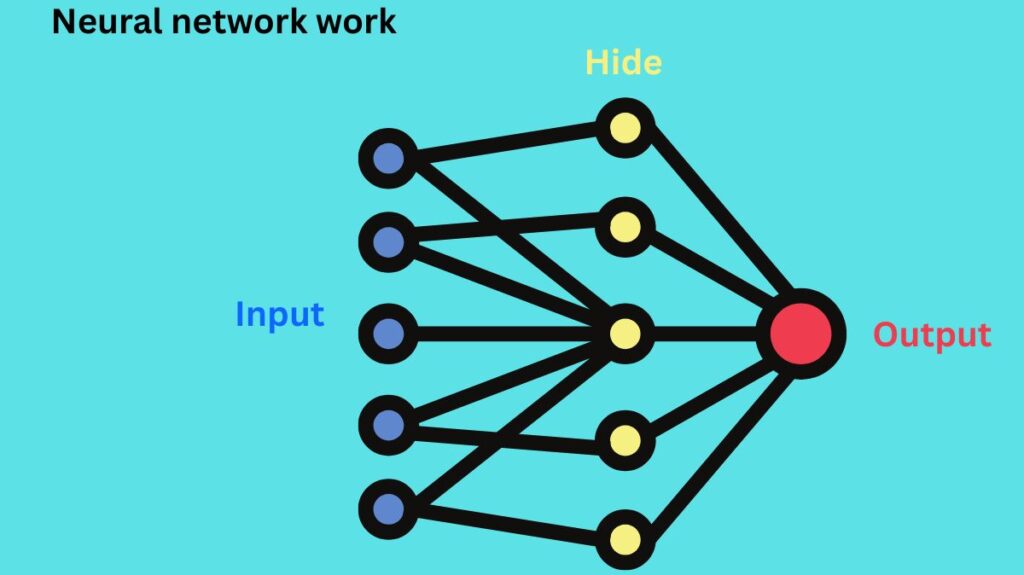
Neural networks are essentially models of how the human brain processes information. It is an adaptable system that learns and gets better over time to model patterns and relationships between data, solve complicated issues, and mimic natural language processing.
Neurones or nodes basic units are coupled and arranged in layers inside this network. An input layer receives the input data, followed by one or more hidden layers that spread the data and an output layer that transmits the analysis or NLP result.
How does a neural network work?
A neural network analyses the values or data it gets in its input layer to simulate the human brain, forecasting and disseminating a conclusion. The second layer receives the data from the input layer and forwards it to the subsequent hidden levels.
The neurones or nodes in the second layer aggregate the data after identifying and filtering highly relevant patterns. The input weight is changed by assigning a weight to each input value. A logistical or sigmoid function defines and sums up these resulting values.
The foundation of this approach is the idea that every collection of parameters can be combined in some way to forecast a particular outcome. In order to apply the optimal set of parameters for a given problem that is, to make a prediction and produce an output the neural network is in charge of doing so.
How is a neural network trained?
In order to provide the most tailored solution to the problem, a neural network is trained by adjusting the input value weights on each node in its structure. In other words, a learning process is used to train a neural network.
Types of neural networks
Neural networks can be classified into the following types based on how the data is transferred from the input nodes to the output nodes:
- Feedforward neural networks: With feedforward neural networks, data is processed from the input node to the output node in a single direction.
- Backpropagation neural networks: these networks follow different routes within the network, but the values are still moved from the input node to the output node. Through the use of a feedback loop, the network determines which of these paths is accurate.
- Convolutional neural networks: Multiple hidden layers in convolutional neural networks are trained to perform distinct and specialised mathematical tasks, including synthesis or filtering. They are highly helpful for recognizing and classifying images.
Types of neural network learning
The neural network may use a variety of learning techniques during training:
- Monitored or controlled learning: An outside agent demonstrates to the system the patterns and output it should produce in monitored or controlled learning. The network will perform computations and combinations in this manner to ensure that its output meets expectations.
- Unsupervised learning (no outside influence): the results of this procedure are uncertain. Only the observations of the input values serve as the foundation for the network.
- Enhanced learning: in this learning process, the analysis is carried out by the network itself, but the results are assessed afterwards. While incorrect outputs are rejected, each correct output receives positive reinforcement.
- Hybrid learning: The aforementioned mechanisms are combined in hybrid learning.
Neural network Applications
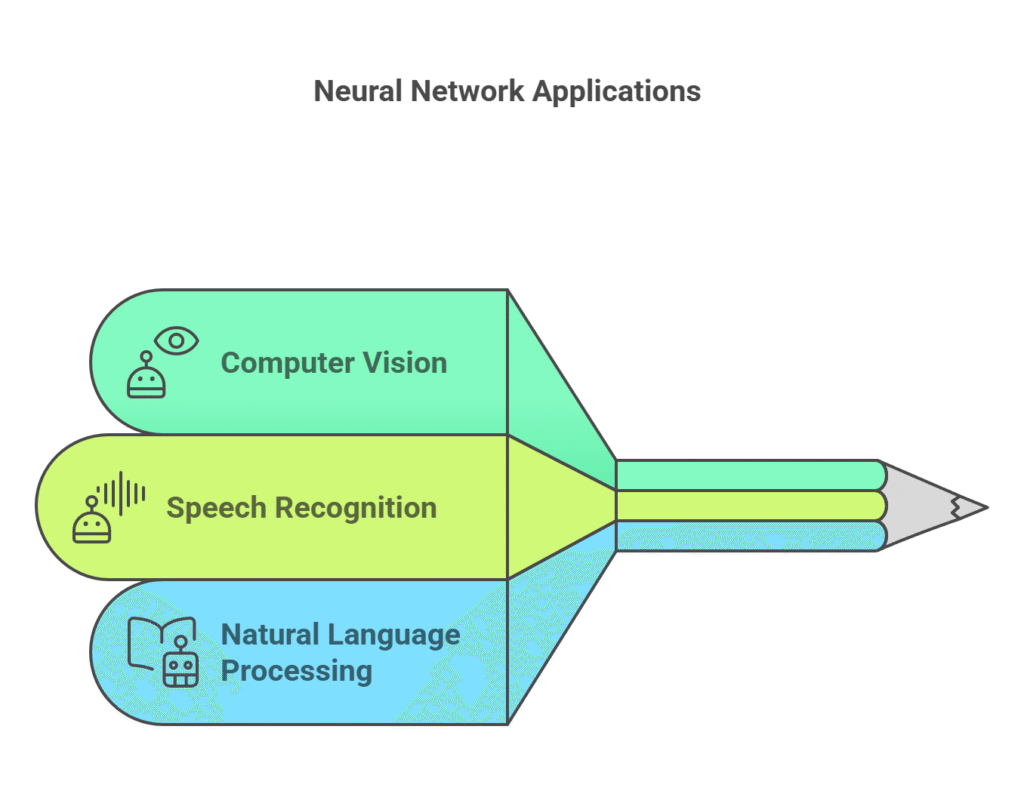
Pattern identification and classification, event prediction, sentiment analysis, data analysis, and computer and robot monitoring are among applications of neural networks. The most popular uses are:
Computer vision
By using neural networks, computers can be given “artificial vision,” or the capacity to discriminate between images, in a way that is comparable to how humans do it. For instance, car systems that can identify other road users or traffic lights.
Speech recognition
Neural networks are used by a variety of technologies, including video subtitling software, virtual assistants, and automatic transcription software, to analyse human speech independent of the language, accent, or tone of the speaker.
Natural language processing
For computers to effectively complete the natural language processing (NLP) process, neural networks are also used in natural language technology. This allows for the processing of texts or documents, the extraction of information, and the determination of the data’s meaning.
For instance, sentiment analysis for comments on social media or chatbots.
How neural networks work in NLP
- NLP models now have a great deal of ability to comprehend and mimic human language to neural networks. They have made it possible for robots to anticipate words and discuss subjects that were not previously covered in the learning process.
- Neural networks need to be trained with a lot of documents (corpora) based on the kind of text or language that has to be processed in order to execute this well in NLP procedures.
- Neural networks play an early role in NLP language models by turning vocabulary words into vectors. They operate on the tenet that a word’s meaning in a text is connected to the words that surround it.
These vectors are employed in basic operations to yield logical semantic outcomes.
What are the advantages of neural networks
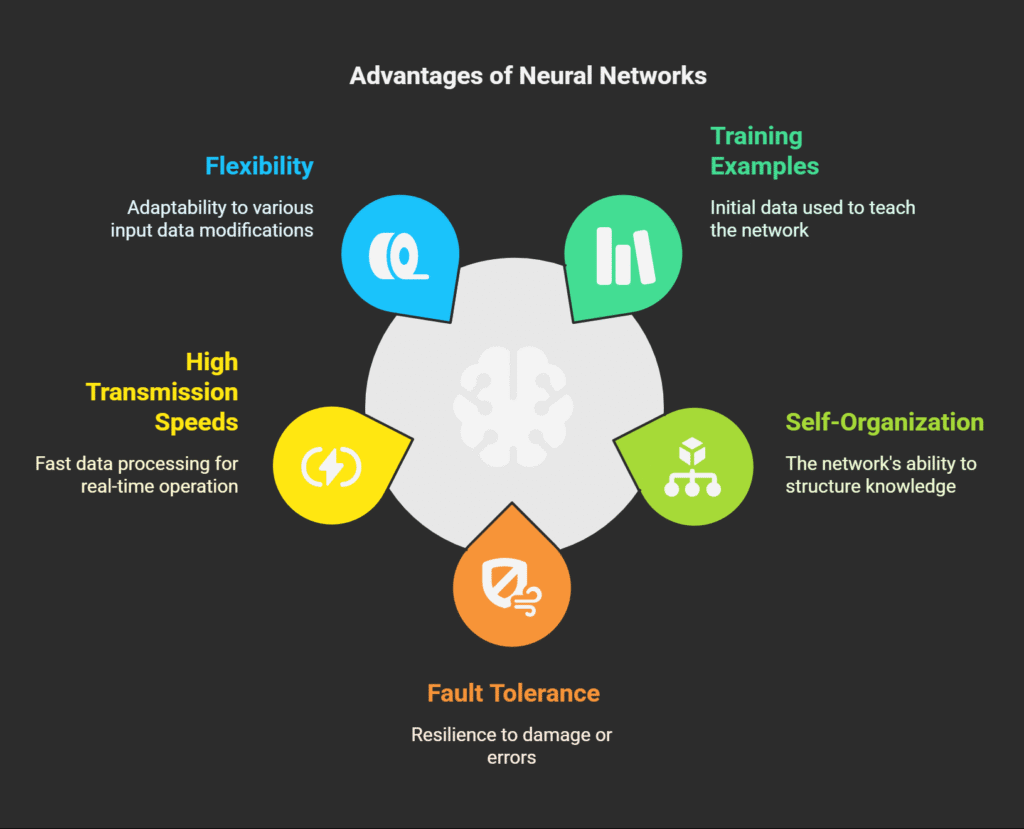
Employing a structure akin to the human brain through the use of neural networks has several advantages, including:
- Neural networks are trained initially using examples that demonstrate the tasks that need to be completed.
- The networks self-organize the knowledge they acquire.
- Fault tolerance: they can react even if there is partial damage.
- High transmission speeds enable real-time operation.
- Flexibility: they are able to handle several modifications to the input data.