

What is a Control Plane
A crucial logical part of networking equipment like switches and routers, the control plane is frequently referred to as the “brain” or intelligence of the network. It is the component of the network architecture that creates the information that dictates the proper flow of data and is in charge of setting the network design.
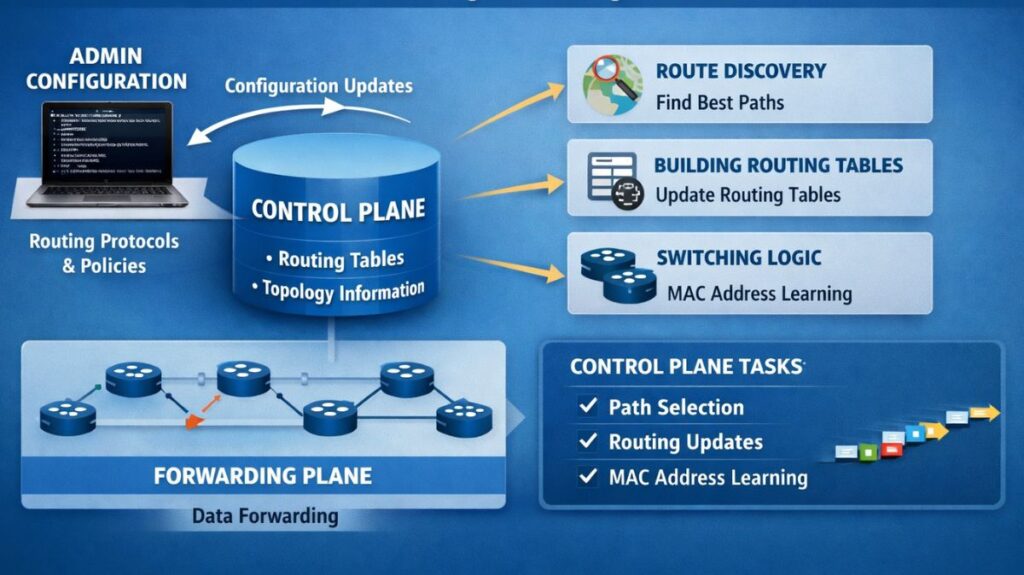
Data Plane (Forwarding Plane) handles high-speed packet forwarding, decision-making, and path computation. The data plane transports packets according to its instructions, while the control plane forwards them.
How It Works
- Routing protocols exchange routing information.
- All routes are stored in the RIB.
- The control plane selects the best route for each destination.
- Best routes are installed into the FIB (used by the data plane)
You can also read Cisco Discovery Protocol, How CDP Works, And Benefits of CDP
Key Functions of the Control Plane
To keep a network robust and operational, the control plane manages the intricate background operations and logic:
- Topology and Routing: Choosing which routes to include in the primary routing database is a key task for topology and routing. Routing protocols including Enhanced Interior Gateway Routing Protocol (EIGRP), Border Gateway Protocol (BGP), and Open Shortest Path First (OSPF) are used by it to talk to other devices and discover the general network architecture.
- Table Management: Important data structures are created and maintained by table management.
- Routing Information Base (RIB): Every route that has been learned is kept in the Routing Information Base (RIB) table.
- Forwarding Information Base (FIB): The high-speed data plane uses the forwarding information base (FIB) to look up packets after the control plane uses the RIB to determine the optimum pathways.
- Path Selection and Adaptability: The “best path” to a destination is determined by cost or distance. Besides monitoring network topology, it can dynamically discover link faults and recalculate a new data rerouting path.
- Policy Enforcement: ACLs and QoS rules, which define traffic priority, are network policies monitored and enforced by the control plane.
- Load Balancing: Network traffic is divided among numerous servers to increase system availability with load balancing.
- Address Resolution: Network addresses are resolved to data-link addresses required for forwarding decisions by it through the use of protocols like Address Resolution Protocol (ARP) for IPv4 and Neighbor Discovery Protocol (NDP) for IPv6.
Difference between Control Plane and Data Plane
The control plane and data plane are conceptually separated, which allows each to be optimized for different tasks:
| Feature | Control Plane (The Brain) | Data Plane (The Muscle) |
| Primary Goal | Intelligence, path calculation, and policy. | High-speed packet forwarding and delivery. |
| Key Role | Determines how and where traffic should go. | Moves the actual traffic based on those rules. |
| Logic Level | Complex (If link A is down, use link B). | Simple (If destination is X, send to Port 1). |
| Common Hardware | General-purpose CPU and System RAM. | Specialized ASICs, FPGAs, and TCAM. |
| Performance Needs | High complexity, lower throughput. | High throughput, ultra-low latency. |
| Key Components | Routing Information Base (RIB), ARP Table. | Forwarding Information Base (FIB), MAC Table. |
| Protocols | OSPF, BGP, EIGRP, ICMP, STP. | IP, TCP, UDP, Ethernet, MPLS. |
| Analogies | Air traffic control tower / Stoplights. | The airplane / The cars on the road. |
The data plane is inherently dependent on the control plane; it cannot forward traffic unless the control plane has first established the routing table and forwarding logic. If the control plane fails, the device becomes “blind” and unable to adapt to any changes in the network.
You can also read What Are The Advantages And Disadvantages Of LAN
Different Architectures
The organization of the network determines how the control plane is implemented:
- Traditional Networking (Distributed Control Plane): In conventional networks, the logic of the control plane is dispersed among all devices, entailing independent decision-making and operation of each router or switch.
- Software-Defined Networking (SDN): Data and control planes are separated by software-defined networking, or SDN. It is common practice to concentrate the control plane functionality into a single software program called “SDN Controller.” From a single location, this controller controls the logic of the entire network and transmits commands to the forwarding devices, freeing them up to concentrate only on high-speed data plane operations.
If the network were essentially a city’s road system, the data plane would be the flow of automobiles really traveling on the roads in accordance with the regulations, while the control plane would be the municipal planning office and the traffic lights, which decided the road network and established the flow rules.