

In this article we learn about Software Defined Networking, Benefits of Software Defined Networking, SDN Architecture, How SDN Works and SDN vs. Traditional Networking.
The modern network architectural technique known as Software-Defined Networking (SDN) makes use of software control to make networks more dynamic, programmatically efficient, and more easily adaptable to changing needs. It signifies a change in paradigm from hardware-controlled traditional networking to software-controlled networking.
The fundamental idea of SDN is the decoupling or separation of the Data Plane (the actual devices in charge of traffic forwarding) from the Control Plane (the network logic or decision-making).
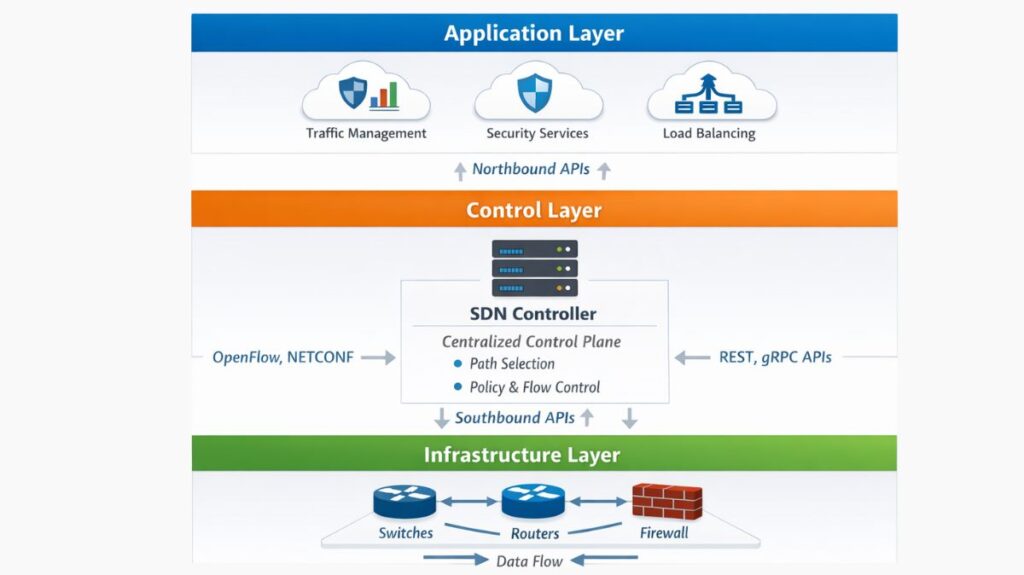
SDN Architecture: The Three Layers
Standard application programming interfaces (APIs) are used to facilitate communication across the three levels that make up SDN:
- Application Layer: Including network applications and services like load balancers, firewalls, intrusion detection systems, and optimization tools, this is the creative center. These programs establish business requirements and network policies (the “blueprint”) and use Northbound APIs to convey these requirements to the controller.
- Control Layer (The Brain): The centralized SDN Controller, which serves as the network operating system and keeps an overall network view, is located in this layer. The controller converts the Application Layer’s high-level specifications into comprehensive hardware instructions.
- Infrastructure Layer (The Muscle): The data plane’s physical or virtual switches and routers (forwarding elements) make up the infrastructure layer, sometimes known as the “muscle.” These devices only follow the precise guidelines, or rules, that the controller gives them while forwarding traffic. The controller and hardware communicate with each other through Southbound APIs like OpenFlow.
You can also read Importance Of Computer Network Security Protect Your Data
Components of SDN
The three primary parts of the SDN are:
- SDN Applications: Using an API, SDN Applications route networks or requests through the SDN Controller.
- SDN Controller: SDN Controller sends network data to apps after gathering it from hardware.
- SDN Networking Devices: These devices aid in data processing and forwarding.
How SDN Works
Administrators may regulate traffic from a single console in an SDN environment since network administration is centralized through the controller.
- An SDN switch searches its flow table for a matching rule when a data packet reaches it.
- If there is a rule, the package is sent right away.
- The switch notifies the central controller if no rule matches.
- Using the Southbound API, the controller, which has a global view of the network, installs a new flow rule into the switch’s flow table after deciding on the best course of action.
- This new rule will be applied to subsequent packets that follow the same path.
Why Organizations Move to SDN
Scalability and cloud integration are SDN’s main motivators.
- Cost: Businesses can employ less costly, standardized hardware instead of shelling out more money for “intelligent” custom switches by utilizing a software controller.
- Speed: The creation and destruction of virtual machines (VMs) in a contemporary data center happens in a matter of seconds. Conventional manual networking is unable to match this pace.
- Self-Healing: In milliseconds, an SDN controller recognizes the cut in a fiber optic cable and sends new “flow rules” to each switch along the line to reroute traffic.
You can also read Computer Network Security Measures: Protect Your Network
Different SDN types
- Open SDN: Uses standard protocols like OpenFlow for controller-switch communication.
- API-based SDN: Relies on vendor-specific or open APIs for control.
- Overlay SDN: Creates virtual networks on top of existing physical infrastructure.
- Hybrid SDN: Blends SDN with traditional networking in one environment.
Benefits of Software Defined Networking and Use Cases
SDN is highly prized for its capacity to improve efficiency, programmability, and flexibility in contrast to traditional networks, where configuration is usually manual and device-by-device and control is dispersed.
Primary Advantages:
- Centralized Management and Simplified Operations: Administrators may observe and manage the entire network from a “single pane of glass,” which simplifies operations and reduces complexity and human error.
- Automation and Programmability: The network can be thought of as code, which enables “Self-Healing” capabilities, task automation, and the rapid rollout of new services.
- Cost Reduction: Since the software controller houses the intelligence, organizations can employ less expensive, standard hardware often referred to as “white-box” hardware which lowers both capital and operating costs.
- Enhanced Security: Centralized control makes it possible to quickly implement consistent security policies throughout the network and supports features like micro-segmentation, which isolates workloads for improved security.
- Flexibility and Agility: SDN makes it possible to quickly adjust to shifting traffic patterns and corporate requirements.
Common Applications:
SDN is commonly employed in settings that demand a high degree of size and dynamism, like:
- Data Centers: Thousands of virtual machines must be managed in data centers, and network configurations must adapt as they move.
- Cloud providers: Giving consumers the ability to quickly build and destroy virtual networks.
- SD-WAN (Software-Defined Wide Area Network): Software-Defined Wide Area Networks, or SD-WANs, use SDN principles to control wide-area connection. They frequently use the internet to safely connect branch offices and automatically select the quickest routes.
SDN vs. Traditional Networking
It’s common to compare the transition from individual physical servers to cloud virtualization with the change from traditional to software-defined networking.
| Feature | Traditional Networking | Software-Defined Networking (SDN) |
| Control Logic | Distributed: Every router/switch makes its own decisions independently. | Centralized: A central “Controller” makes decisions for the entire network. |
| Control & Data Planes | Integrated: Both planes live inside the same physical box. | Decoupled: The Control Plane is software-based; the Data Plane is hardware. |
| Configuration | Manual: Admins must log into each device one by one (CLI). | Automated: Programmatic changes via APIs or a central dashboard. |
| Programmability | Non-Programmable: Fixed functions based on vendor firmware. | Highly Programmable: Network behavior can be written as code. |
| Visibility | Limited: Only see what is happening on directly connected neighbors. | Global: The controller has a “bird’s-eye view” of the entire topology. |
| Agility | Static: Changes take hours/days to push across all devices. | Dynamic: Real-time adjustments can be made “on the fly.” |
| Hardware | Proprietary: Locked into specific vendors (Cisco, Juniper, etc.). | Open/Commodity: Can use cheaper “White Box” switches. |
| Interfaces | Closed: Uses vendor-specific protocols and command lines. | Open: Uses open standards (OpenFlow) and Northbound/Southbound APIs. |
SDN can be conceptualized as a GPS navigation system to grasp the idea: The Switches are the vehicles that follow the routes, the SDN Controller serves as the Google Maps server, the central intelligence that determines the optimal way, and the Flow Rules are the precise directions or routes that the central intelligence has determined.