

Software Defined Architecture
Software Defined Architecture (SDA) is a contemporary approach to IT design and operation in which intelligent software handles control, administration, and policy implementation, abstracting these tasks from the underlying physical hardware. Moving businesses away from inflexible, hardware-centric systems, SDA offers the framework for developing digital infrastructures that are scalable, automated, and flexible.
In the context of network management, Software Defined Networking (SDN), which is frequently used interchangeably with SDA, is the most well-known and significant application of SDA.
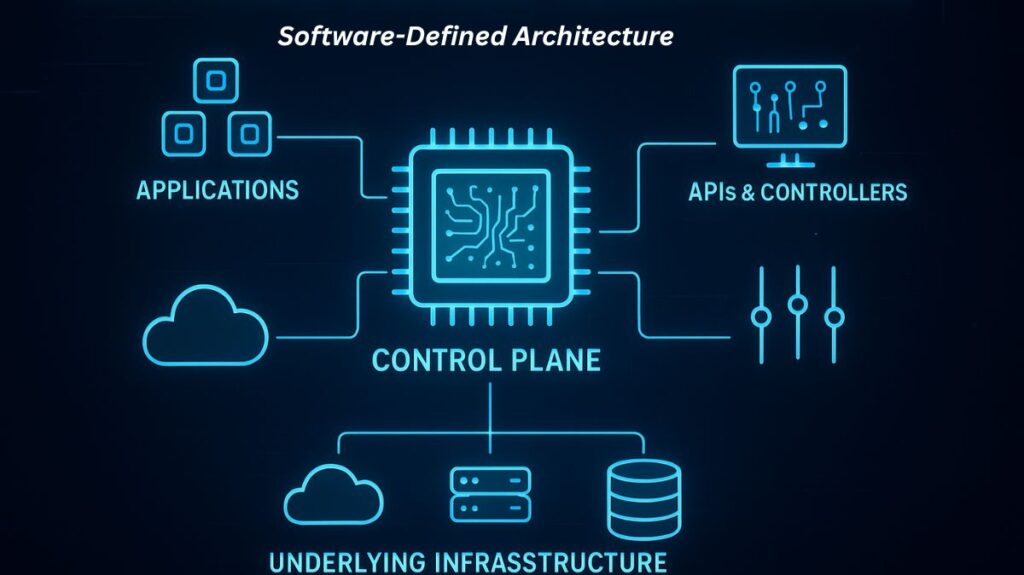
Core Principles: Abstraction and Decoupling
SDA’s core idea is the division and centralization of infrastructure functions:
- Separation of Planes: Conventional networking devices implement a distributed design in which each device manages its own processes and combines the control, data, and management planes. Software-defined architecture and SDN alter this by consolidating some of these tasks into a controller.
- Data Plane (Forwarding Plane): It encapsulates and de-encapsulates messages, matches IP addresses to the routing table and destination MAC addresses to the MAC database, throws away communications due to filters. Usually, this function requires Ternary Content-Addressable Memory (TCAM) and Application-Specific Integrated Circuits for fast processing.
- Control Plane: Control plane procedures and protocols create data necessary for data plane forwarding decisions. With SDN, the control plane’s operations can be transferred entirely or in part to a controller, which is a centralized application. ARP, NDP, switch MAC learning, STP, and routing protocols (OSPF, EIGRP) are a few instances of control plane operations.
- Management Plane: Telnet, SSH, and SNMP are just a few of the protocols and software that network engineers use to manage and query devices. Protocols like Telnet, SSH, and SNMP are used by SDN controllers to communicate with the management plane, particularly when it comes to controlling conventional network equipment.
- Centralized Control: The network’s intelligence is moved to this virtual control plane from its original location in separate hardware units. The SDN controller gets a global view of the network.
- Programmability: APIs allow programs to configure infrastructure without device-by-device interaction.
You can also read What Is Data Encapsulation In Networking & De-Encapsulation
The Three-Layered Architecture
Three logical layers that communicate through APIs are commonly seen in Software-Defined Networking (SDN) designs, which are the primary implementation of SDA:
| Layer | Function/Role | Interface |
|---|---|---|
| Application Layer (Top) | Programs (e.g., firewalls, load balancers, intrusion detection systems) that define the required network policies, services, and behavior. These applications relay requests to the controller. | Northbound Interface (NBI) |
| Control Layer (Middle) | The centralized SDN Controller acts as the network operating system, maintaining the network state and translating application requirements into specific, detailed instructions for the hardware. | Southbound Interface (SBI) |
| Infrastructure Layer (Bottom) | Physical devices that execute the forwarding instructions from the controller. | Routers, switches, and other network devices (Data Plane). |
Inter-Layer Communication
- Northbound Interface (NBI): The Northbound Interface (NBI) serves as a link between the Control and Application layers. Applications can quickly create automation scripts thanks to this interface, which makes the controller’s data and functionalities accessible to them (network programmability). In this case, RESTful APIs are typical.
- Southbound Interface (SBI): The infrastructure layer and the control layer are connected by the southbound interface (SBI). The controller programs the device configurations or forwarding tables directly using the SBI (protocols such as OpenFlow, NETCONF, or OpFlex).
You can also read How Data Flows Through The OSI Model And It’s Importance
Broad Scope of Software-Defined Architecture
SDA includes all aspects of the data center infrastructure, not just networking.
- Software-Defined Networking (SDN): For dynamic traffic management, Software-Defined Networking (SDN) separates control from packet forwarding.
- Software-Defined Storage (SDS): Storage management and the actual disks that underpin it are separated by Software-Defined Storage (SDS), which enables centralized, adaptable storage resource provisioning (such as DAS, SAN, or NAS).
- Software-Defined Compute (SDC): Virtualization, such as hypervisors, is used in Software-Defined Compute (SDC) to abstract and pool server resources.
- Software-Defined Data Center (SDDC): All networking, storage, and computing components are fully virtualized and integrated in a software-defined data center (SDDC), where software is used to deliver and manage the whole infrastructure.
Key Benefits of SDA/SDN
SDA principles have huge commercial benefits due to centralization and automation:
- Flexibility and Agility: The network can be programmed to react to changing demands or application specifications in virtually real time.
- Automation: Automating bulk configuration and provisioning activities improves consistency and reduces errors.
- Centralized Management: Centralized administration makes it easier to administer, debug, and implement policies from a single console by giving administrators a single, integrated view of the complete network.
- Cost Savings: SDA lessens reliance on pricey, proprietary hardware, frequently enabling networks to be constructed with less expensive commodity gear.
- Enhanced Security: Centralized control makes it easier to apply uniform security policies, permits the application of fine-grained controls, and permits the use of strategies such as micro-segmentation.
Network management can be thought of as conducting an orchestra to comprehend the change. The score (configuration) is individually interpreted by each musician (device) in a typical arrangement. To ensure harmony and enable quick, centralized modifications, a Software-Defined Architecture uses a central conductor (the SDN Controller) to interpret the entire song (the network intent or policy) and tell each musician exactly what to perform.
You can also read What Is A Firewall? History Of Firewalls, Types Of Firewalls