

In this article, we learn about Hub and Spoke Topology Definition, How it Works, Hub and Spoke Topology Advantages and Disadvantages, and Specific Hub-and-Spoke Topologies.
Hub and Spoke Topology Definition
Wide Area Networks (WANs) frequently use the hub-and-spoke topology, a hierarchical network architecture, to link several distant locations to a single hub. This architecture, which emphasizes the logical flow of data through a central control point, is frequently chosen for WANs, cloud environments, and logistical systems.
The hub-and-spoke design is essentially the same as a star topology in terms of its physical arrangement. It is also known as a point-to-multipoint topology or a partial mesh.

How it Works
The Hub and the Spokes are the two primary elements that define the topology.
- The Hub (Central Node): The hub, also known as the central node, is the center of the network and is usually a central office, a major data center, or a strong router. It acts as the main hub, controlling all routing, security, and spoke-to-spoke communication. Hubs in an SD-WAN setting are typically found in a customer point of presence (PoP) or data center. Hub devices can serve as gateways, allowing access to a wider network and forwarding Layer 3 traffic.
- The Spokes (Peripheral Nodes): The distant locations, branch offices, or branch devices are known as the Spokes (Peripheral Nodes). Every spoke is directly connected to the Hub via a specialized Point-to-Point (P2P) connection. Spokes are branch devices in an SD-WAN system that often feature LAN ports that allow endpoint devices to connect to the network.
You can also What is Point to Point Topology Network, Pros and Cons
Communication Flow: Centralization is this topology’s most distinctive feature.
- Spoke to Hub: The Hub receives all traffic that comes from a Spoke.
- Spoke to Spoke: Data must first reach the Hub before being routed or forwarded to the destination Spoke in order for one Spoke to speak with another. All communications are received and forwarded via the central hub, which also acts as a data mediator and gives packet transmission priority.
The hub-and-spoke architecture is used in wide area networks to link several branch offices (the spokes) to a corporate headquarters (the hub). Through a transport network, such as the internet, an MPLS network, or both, every hub and spoke device is connected to an SD-WAN Controller.
Hub and Spoke Topology Advantages and Disadvantages
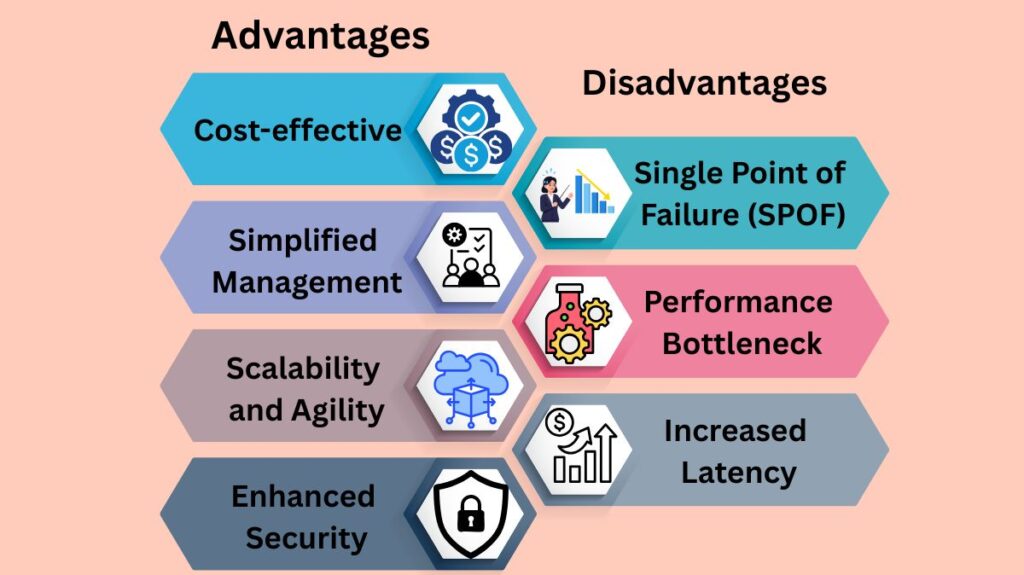
Advantages
Particularly in big, dispersed networks like WANs, hub-and-spoke topologies have a number of advantages.
- Cost-effective: Compared to alternative networking topologies, such a full mesh network, this architecture is typically less expensive. It can save money because it only needs as many connections as there are nodes, requiring fewer WAN lines and gear.
- Simplified Management: Since everything passes through a single location, centralized control simplifies administration, monitoring, and troubleshooting.
- Scalability and Agility: As network requirements change, it enables businesses to swiftly and simply add or remove spoke devices. To manage more traffic, only the central hub needs to be expanded.
- Enhanced Security: Since all traffic must go via the hub, firewall, antivirus, and malware detection services, as well as centralized security policies, can be set up and implemented at a single inspection point.
You can also read What is PEAP Protected Extensible Authentication Protocol?
Disadvantages
The hub-and-spoke topology has inherent drawbacks despite its advantages:
- Single Point of Failure (SPOF): All spoke-to-spoke communication or the network as a whole becomes inoperable if the central hub fails. This risk can be reduced by using redundancy techniques like a Dual-Homed topology, which provides a second hub.
- Performance Bottleneck: Under high load, the hub may become overwhelmed and function as a performance bottleneck since it must process and manage all traffic.
- Increased Latency: Spoke-to-Spoke communication requires two hops ((Spoke → Hub → Spoke), which increases the total travel time or latency.
Specific Hub-and-Spoke Topologies (SD-WAN Examples)
Numerous hub-and-spoke topologies are possible, and they are frequently controlled by Versa Director workflow templates that enable network topology changes as needed:
- Spoke to Hub Only: In this setup, spokes are unable to connect directly or via their hub with other spokes; instead, they can only send traffic to networks situated behind a hub. When the spokes’ primary need is to access central services, this is helpful.
- Spoke to Spoke Through a Hub: All traffic must pass through the central hub for spokes to connect with one another. For tasks like central filtering or in deployments with a lot of sites (more than 100, for example), this is advantageous.
- Spoke to Spoke Direct: Spoke groups are formed by connecting member spokes in a full-mesh topology that permits direct communication. Through the hub, spoke devices are also able to stay connected to other spoke groups. Traffic from two spokes must still go via the hub even if they are not linked to the same WAN transport network (for example, one uses only the internet, while the other uses only MPLS). In the event that a direct link fails, this direct configuration can also offer a backup option via the hub.
- Spoke-Hub-Hub-Spoke (SHHS): This intricate design divides spokes and hubs into discrete areas to increase scalability in sizable, widely separated SD-WAN networks. Spokes link to local hubs within an area, frequently in a configuration that reflects another topology. Traffic routing from the local spoke to its hub, then via hubs in other regions, and ultimately to the destination spoke, makes it easier for spokes in different regions to communicate with one another.
A hub-and-spoke WAN topology functions similarly to an aviation route system: Numerous smaller cities (the Spokes) are connected to a major airport (the Hub). When travelling between two smaller cities, passengers must always change aircraft at the main airport. Although this centralizes management and control, all distant cities lose connectivity in the event that the main airport closes.
You can also read What is EAP-TLS Meaning, How EAP TLS Works & Advantages