

What is Frame Relay Meaning
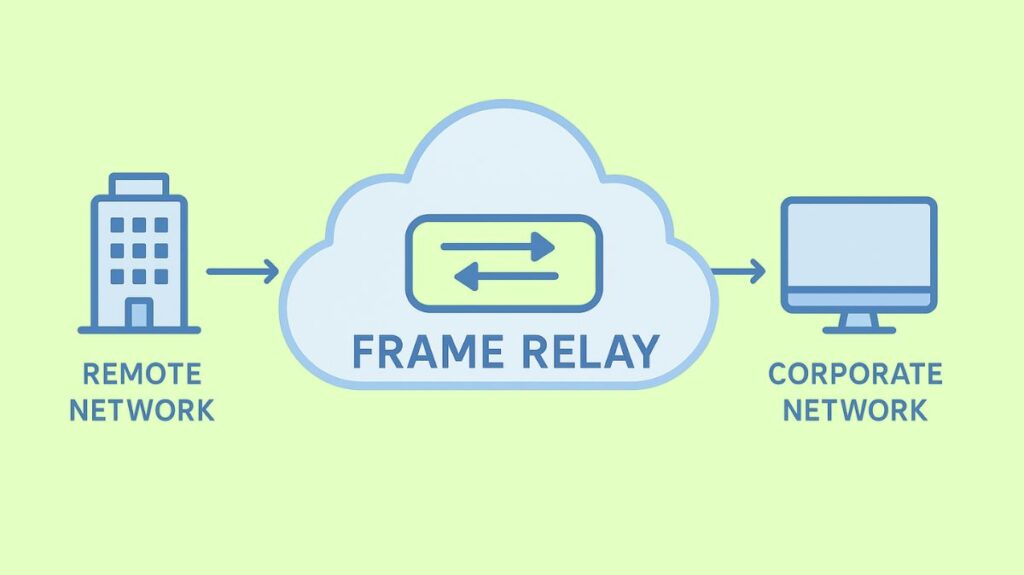
The Open Systems Interconnection (OSI) reference model’s Physical and Data Link layers (Layer 1 and Layer 2) are where Frame Relay (FR), a standardized Wide Area Network (WAN) technology, largely functions. It is essentially a packet-switching technology that connects local area networks (LANs) over a wide area network (WAN) to offer economical data transport for sporadic traffic.
In networking diagrams, Frame Relay is frequently shown graphically as a “cloud” and offers a connection-oriented service.
Origin and Efficiency
Frame Relay originated as a streamlined version of the older X.25 packet-switching protocol.
- Reduced Overhead: X.25 needed a lot of error correction because it was built to run over noisy analogue phone lines. Frame Relay was created to be sent over more recent, dependable digital networks with significantly reduced error rates (almost zero), such as the Integrated Services Digital Network (ISDN).
- Fast Packet Switching: Frame Relay does away with X.25’s per-virtual-circuit flow control and comprehensive error correction. This technology is known as “fast packet.”
- Usage and Speed: Frame Relay is a WAN protocol that is usually set up on serial interfaces in conjunction with PPP and HDLC. It usually operates between 64 Kbps and 45 Mbps (T3). 56 kbps, 64 kbps, or 1.544 Mbps are typical access speeds.
- Error Handling: Frame Relay divides data into “frames,” which are variable-sized units. A Frame Relay network merely drops a frame when it finds an issue in it (using the Frame Check Sequence, or FCS). The endpoints or higher-layer protocols (like TCP) are in charge of identifying lost data and requesting retransmission. In comparison to X.25, this lack of link-by-link error correction results in reduced overhead, improved channel efficiency, and increased performance.
- Cost Effectiveness: Compared to dedicated point-to-point leased links, it may be less expensive. For instance, three distinct Permanent Virtual Circuits (PVCs) to three branch offices can be supported by a single physical T1 at a central office, saving money on extra T1 interfaces and equipment.
- Market Status: Frame relay is becoming less prevalent, despite maintaining a small market share. For many businesses, MPLS has largely taken the place of Frame Relay networks. Most current CCNA tests no longer feature frame relay.
You can also read What is Point to Point Protocol Over Ethernet PPPOE Benefits
Core Components and Operation
Devices
Frame Relay defines two types of equipment:
- DTE (Data Terminal Equipment): The user device, like a router, is known as DTE (Data Terminal Equipment).
- DCE (Data Circuit-Terminating Equipment): The carrier equipment that frequently supplies the clocking signal is known as DCE (Data Circuit-Terminating Equipment), and it is typically the Frame Relay switch.
Virtual Circuits (VCs)
Frame Relays create logical, two-way communication channels between two endpoints using a common physical link by using virtual circuits:
- Permanent Virtual Circuits (PVCs): PVCs, or permanent virtual circuits, are the most prevalent kind. The connection appears to the consumer as a dedicated, long-term line without the expense of a full-time leased line because it is administratively configured by the service provider and is continually maintained.
- Switched Virtual Circuits (SVCs): Temporary connections known as switched virtual circuits (SVCs) are created just when data transfer is required and are then terminated.
Data Link Connection Identifiers (DLCIs)
Each PVC is identified by a Data Link Connection Identifier (DLCI).
- To let the receiving end know which logical path a frame belongs to, the DLCI is a numerical identifier (a 10-bit value in the address field) that identifies the virtual link.
- Since DLCIs usually have local significance, the particular DLCI number merely indicates the link between the local Frame Relay switch (DCE) and the user device (DTE). Different DLCI numbers may be used by two endpoints connected to the same virtual circuit.
Local Management Interface (LMI)
The LMI is a collection of Frame Relay extensions created by a group of companies, including StrataCom, Cisco, and others, to make management and signaling easier in intricate internetworking settings. Important LMI features include:
- Virtual Circuit Status Messages: These stop data from being transmitted over nonexistent circuits (black holes) by periodically reporting on the integrity and state of PVCs (Active, Inactive, Deleted).
- Global Addressing (Optional): By giving DLCI values global rather than local significance, this modification makes address resolution easier by enabling DTEs to be recognized like any other LAN device.
- Multicasting (Optional): This extension saves bandwidth while transmitting routing updates by enabling a sender to send a single frame to several recipients using reserved DLCIs.
Addressing and Non-Broadcast Multi-Access (NBMA)
By default, Frame Relay is categorized as a Non-Broadcast Multi-Access (NBMA) network, which means that broadcasts across all virtual circuits are not supported natively. Devices at the network layer (Layer 3) need to have their IP addresses mapped to the proper Layer 2 DLCIs to communicate:
- Inverse ARP (IARP): The router can dynamically resolve a remote router’s network layer address (IP) to a local DLCI via the Inverse ARP (IARP) method.
- Static Mapping: The mappings need to be manually defined if IARP is not being used.
A physical interface can be separated into logical subinterfaces, with each PVC configured on its own point-to-point subinterface, in order to enable appropriate routing protocols and get around split horizon problems that are common in NBMA systems.
You can also read What is Network Control Protocol, Role and Function of NCP
Congestion Control and Quality of Service (QoS)
Explicit mechanisms are used by Frame Relay to control congestion and manage traffic:
- Committed Information Rate (CIR): The average rate (in bits/second) at which the network promises to transport data during a measurement interval is known as the committed information rate, or CIR. If network resources are available, users can transfer data beyond the CIR Frame Relay’s provision for bursty data flow.
- Discard Eligibility (DE) Bit: The DE bit is frequently used to identify frames that are supplied in excess of the guaranteed CIR. Packets with the DE bit set are dropped first if the network gets crowded.
- Explicit Congestion Notification Bits:
- FECN (Forward Explicit Congestion Notification): A bit set by a crowded switch in frames heading towards the destination that notifies the destination DTE that congestion has occurred is known as FECN (Forward Explicit Congestion Notification).
- BECN (Backward Explicit Congestion Notification): A bit set by a congested switch on frames returning to the source, known as BECN (Backward Explicit Congestion Notification), tells the sender to lower its transmission rate to prevent network collapse.
Configuration Considerations
- Encapsulation Types: Cisco routers default to proprietary Cisco encapsulation. If connecting to a non-Cisco router, the standardized IETF encapsulation must be specified using the command
encapsulation frame-relay ietf.
- Subinterfaces: A physical interface can be separated into logical subinterfaces to provide full routing updates and address split-horizon problems that are frequently seen in NBMA systems. Every PVC is set up on a separate subinterface, which is frequently referred to as point-to-point. An IP address shouldn’t be assigned to the physical interface when subinterfaces are being used.
Verification Commands
Common commands used to monitor and verify Frame Relay operation include:
show frame-relay map: Displays Network layer address (IP) to DLCI mappings (static or dynamic).show frame-relay pvc: Displays the status of configured PVCs (Active, Inactive, Deleted), DLCI numbers, and traffic statistics, including the number of BECN and FECN packets received.show frame-relay lmi: Displays LMI type and traffic statistics (number of status messages exchanged with the Frame Relay switch).debug frame-relay lmi: Used for real-time troubleshooting between the router and the Frame Relay switch.
Market Status
Because Frame Relay was less expensive than dedicated point-to-point leased lines, it was very popular. But in recent years, the technology has lost some of its appeal. Newer technologies like Ethernet via fiber optics, VPNs, dedicated broadband services (DSL and cable modem), and Multiprotocol Label Switching (MPLS) have essentially supplanted it. In legacy network infrastructures, it is still occasionally utilized, especially in industries like government, retail, and banking.
Analogy: A shared digital highway system that links several cities (LANs) is analogous to frame relay. You pay to use the shared highway rather than a private toll road (leased line) that runs between each pair of cities. Because the traffic police (network switches) believe the automobiles (frames) are structurally solid and rely on the endpoints for dependability, they don’t stop and verify every package at every checkpoint, which makes this highway extremely efficient.
A minimum lane capacity (CIR) is guaranteed, but if the highway is clear, you can use all of the available capacity (shared bandwidth). In order to maintain the smooth operation of the important traffic, the police promptly signal the incoming traffic (BECN) or the departing traffic (FECN) whenever traffic slows down. They also promptly discard any vehicles carrying low-priority cargo (designated with the DE bit).
You can also read What is Customer Premises Equipment CPE and Key Functions