

What is Link Control Protocol?
A key element of the Point-to-Point Protocol (PPP) suite, the Link Control Protocol (LCP) functions at the Data Link Layer (Layer 2). It is in charge of overseeing the entire channel of communication, making sure the link is correctly established, configured, maintained, and shut off.
Following the completion of the physical layer, LCP packets are exchanged during the Link Establishment Phase, the first stage of a PPP session. IP and other network-layer protocols cannot be sent over PPP before the Link Establishment and optional Authentication stages are finished.
You can also read PoP Point of Presence Network Improves Internet Performance
Core Responsibilities and Functions
LCP carries out the fundamental operations required for a point-to-point link to operate dependably:
- Establishment and Configuration: LCP is in charge of setting up the data link connection. PPP sends LCP packets before to communication to test the line and determine whether it can provide the necessary data volume and speed.
- Parameter Negotiation: By negotiating link parameters, LCP enables devices to reach a consensus on options. Determining the Maximum Receive Unit (MRU), the maximum permitted frame size that frequently supersedes the 1,500 octet default, is part of this process.
- Peer Identification: It verifies the associated peer’s identity before accepting or rejecting the connection.
- Error Detection: LCP detects configuration issues through error detection.
- Compression: LCP facilitates the negotiation of compression techniques in order to boost throughput.
- Authentication Support: LCP assesses whether authentication is necessary and negotiates the technique (such as Challenge Handshake Authentication Protocol (CHAP) or Password Authentication Protocol (PAP)). After LCP handles the first link setup, the real authentication process takes place.
- Link Testing and Maintenance: LCP keeps an eye on the integrity of the links and tests them frequently.
- Loop Prevention: Loop Prevention LCP detects looped-back circumstances or other link-level irregularities using a Magic Number, a unique, randomly generated identifier. When two identical frames with the same magic number are received, it indicates that the link has been looped back.
- Link Quality: It keeps track of link quality, occasionally with the help of optional Link Quality Reporting (LQR) and Link Quality Monitoring (LQM). The link’s functionality is checked by LCP using Echo-Request and Echo-Reply packets.
- Multilink PPP (MLP): Multiple physical pathways appear as a single logical Layer 3 path to LCP’s facilitation of multilink connections.
- Termination: When a connection needs to be ended, or the link isn’t working properly, LCP gracefully ends the connection. In order for the network-layer protocols to respond appropriately, LCP notifies them when it terminates the connection.
LCP Frame Structure and Types
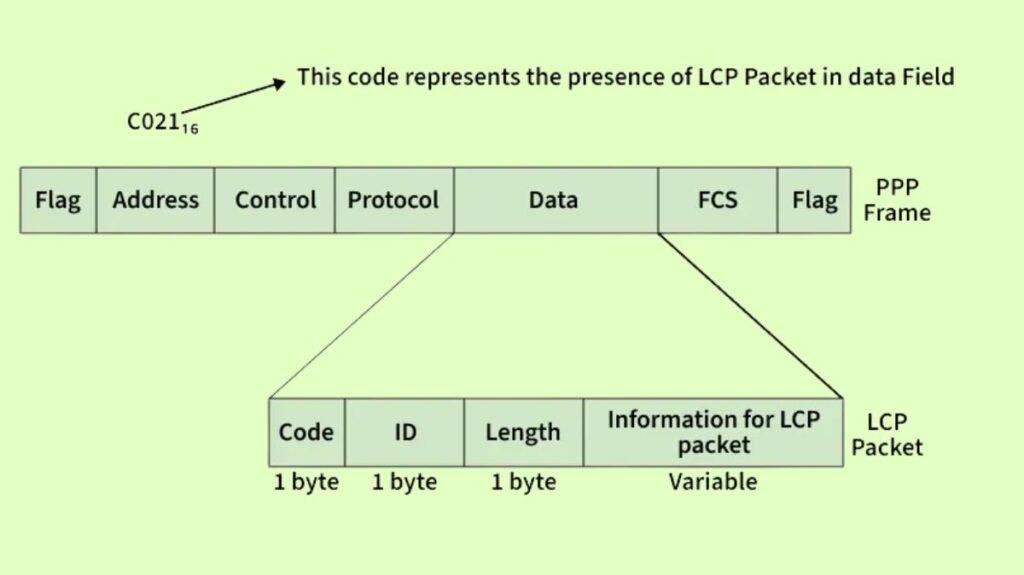
Within the Payload field of the PPP frame, the LCP frame is enclosed. For LCP frames, the precise PPP Protocol ID is 0xc021.
The encapsulated LCP frame includes several fields:
- Code (1 byte): Identifies the type of LCP frame being sent.
- ID (1 byte): Used to match associated requests and replies.
- Length (2 bytes): Holds the total length of the LCP frame.
- Information/Data: Carries the data from the network layer or specific configuration options.
LCP communication relies on three main types of frames, categorized by their purpose:
| LCP Frame Type | Purpose | Key Codes (in Hexadecimal) |
|---|---|---|
| LCP Configuration Frames | Used during the Link Establishment phase to negotiate parameters. | Configure-Request (0x01), Configure-Ack (0x02), Configure-Nak (0x03), Configure-Reject (0x04) |
| LCP Termination Frames | Used to gracefully close the link. | Terminate-Request (0x05), Terminate-Ack (0x06) |
| LCP Maintenance Frames | Used periodically to test and maintain the link. | Echo-Request (0x09), Echo-Reply (0x0A), Code-Reject (0x07), Protocol-Reject (0x08) |
You can also read What Is The Demarcation Point Definition In Networking?
LCP in the PPP Session
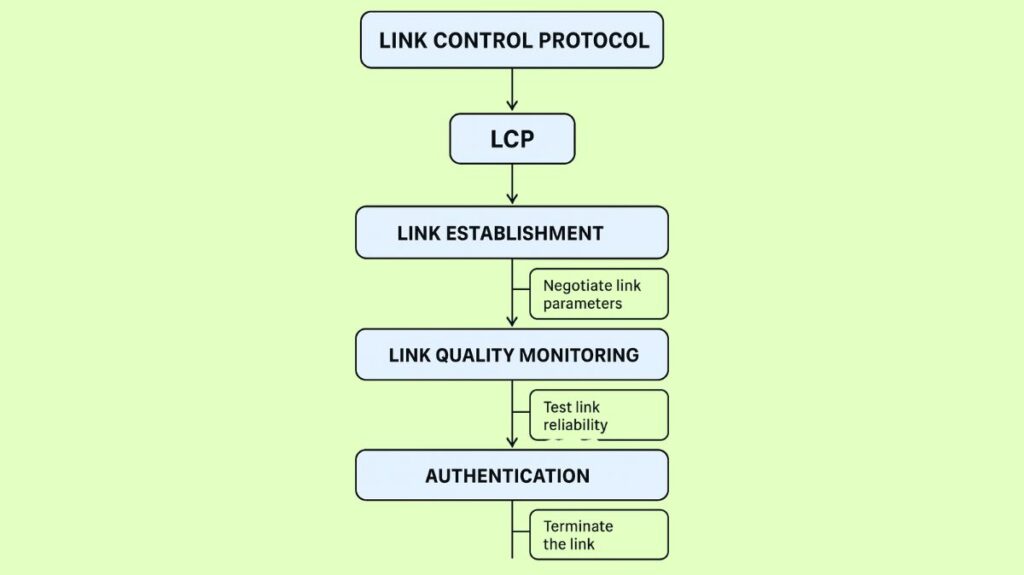
The process of establishing a PPP session usually involves a series of steps, starting with LCP functions. These phases’ tasks are carried out by LCP packets (Link establishment, Link termination, and Link maintenance frames).
The key phases involving LCP are:
- Link Establishment and Configuration Negotiation: In order to configure and establish the data link, the originating PPP node transmits LCP messages. Prior to exchanging network layer datagrams, LCP must establish the connection and negotiate configuration parameters. The exchange of datagrams ends when a configuration acknowledgement frame is delivered and received.
- Link-Quality Determination (Optional): Before introducing network-layer protocols, LCP allows an optional phase to validate that the link quality is sufficient.
- Authentication Phase (Optional): If set up, PAP or CHAP authentication takes place ahead of the Network Control Protocol (NCP) being used for network layer setup, but after the initial link formation (managed by LCP).
- Network Layer Protocol Phase: The relevant Network Control Protocol (NCP) is used to set network-layer protocols (such as IP, which utilizes IPCP) following the completion of the link-quality determination phase by LCP. If LCP decides to end the connection, it will notify the network-layer protocols.
Verification and Troubleshooting
You can check the operational status of LCP (and NCP) on an interface by using the show interfaces command.
- LCP Open will appear in the output if the connection negotiation is successful. This shows that the session establishment process has been finished by LCP.
- LCP Closed or LCP REQsent (sending requests but receiving no replies) may appear in the output if the LCP process was unsuccessful or not completed.
- The LCP process has not finished, as indicated by the status message “LCP closed,” which could be the result of conflicting options or a failed authentication. When one side utilizes PPP encapsulation and the neighboring router uses the proprietary High-Level Data Link Control (HDLC) encapsulation, this is a common cause of LCP failure.
- The
debug ppp negcommand can be used to troubleshoot the PPP protocol negotiation.
If the PPP suite were a bureaucratic system that set up a secure meeting, the Network Control Protocol (NCP) would be the department in charge of handling the actual meeting content (like sending IP packets) after the basic link is confirmed, while LCP would be the receptionist who establishes the initial connection, negotiates security protocols (like CHAP), checks the quality of the phone line, and keeps the line alive.
You can also read What is Local Loop in Networking and Supported Services
