

What is Point to Point Protocol Over Ethernet PPPOE?
A network protocol called Point-to-Point Protocol over Ethernet (PPPoE) was created to encapsulate PPP frames inside Ethernet frames. PPP, which is commonly utilized via broadband connections, is combined with the Ethernet link-layer protocol in PPPoE. This combination enables users to connect to a network of hosts via an access concentrator or bridge and permits data transfer between two network sites.
You can also read PoP Point of Presence Network Improves Internet Performance
Mechanism
Individual connections do not need dedicated routes to PPPoE, which offers a standards-based way to connect numerous customers to an Internet service provider (ISP) using current Ethernet networks. ISPs frequently use PPPoE to manage connections and authenticate users for high-speed connections like fiber and DSL.
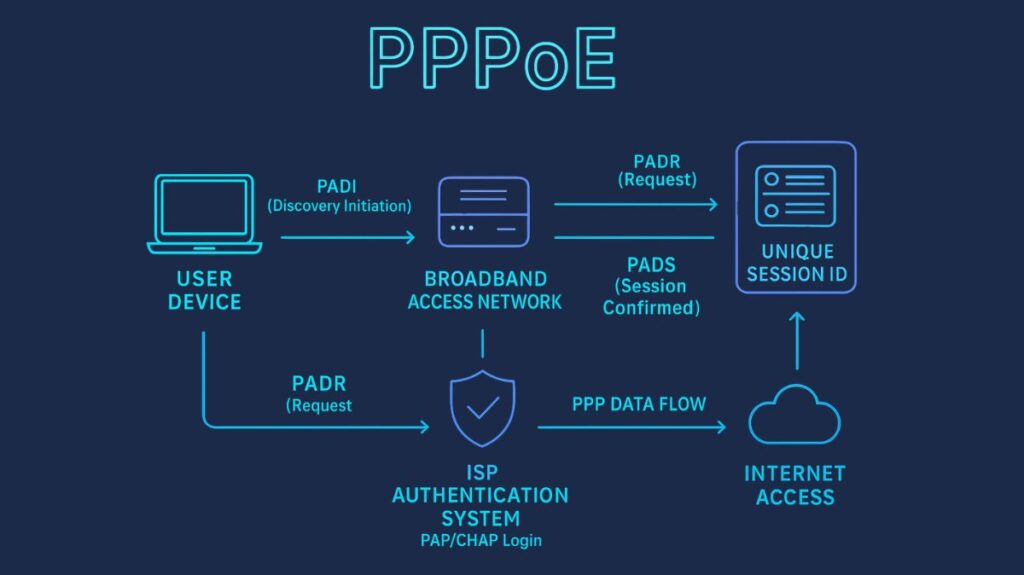
The discovery stage and the PPP session stage are two separate phases in the PPPoE operation described in RFC 2516.
PPPoE Discovery Stage
The host serves as the client in the discovery process, while the access concentrator (AC) serves as the server. Its goal is to create a distinct PPPoE Session ID and discover the distant peer’s Ethernet media access control (MAC) address. EtherType 0x8863 is used to transport discovery packets in Ethernet frames.
The discovery stage consists of four main steps:
- PADI (PPPoE Active Discovery Initiation): To request a service, the client broadcasts a PADI packet to the LAN to start a session (PPPoE Active Discovery Initiation).
- PADO (PPPoE Active Discovery Offer): Any access concentrator that can offer the service responds with a PADO packet that contains its MAC address and name.
- PADR (PPPoE Active Discovery Request): After choosing one AC from the offers, the client sends a PADR packet to confirm acceptance and specify the services required (PPPoE Active Discovery Request).
- PADS (PPPoE Active Discovery Session-Confirmation): By delivering a PADS packet with a distinct session ID for the new PPPoE session, the chosen AC verifies acceptance. The AC resets the session ID to zero and sends a PADS packet with a service name error if it is denied.
- PADT (PPPoE Active Discovery Termination): To end an ongoing session, either the client or the AC may send a PADT packet at any time.
PPPoE Session Stage
Data is transmitted as in any other PPP encapsulation once the PPPoE session has been formed. An Ethernet frame containing PPPoE data is transmitted to a unicast address. During the session stage, there are:
- Authentication: The client uses the PPP Link Control Protocol (LCP) to negotiate connection parameters before sending credentials (password and username) via the more secure Challenge Handshake Authentication Protocol (CHAP) or the Password Authentication Protocol (PAP).
- Network Configuration: Following successful authentication, the client device is assigned an IP address and further network parameters (such as DNS server addresses) via the PPP Network Control Protocol (NCP).
- The peer’s Ethernet address and the session ID are used to uniquely identify the PPPoE session.
Key Features and Benefits
ISPs place a high value on PPPoE because it enables them to effectively manage individual customer connections over a shared network.
- User Authentication and Access Control: PPPoE makes use of PPP capabilities to authenticate users using their username and password, allowing service providers to keep access control. By doing this, unwanted access is avoided.
- Per-User Management and Billing: It enables each client to have their own virtual circuit. This enables features like per-user pricing and customized bandwidth management, and makes it simple to link the allotted IP address to a particular login name.
- Dynamic IP Assignment: To save IP address space, PPPoE enables dynamic IP address assignment from the ISP’s central pool.
- Inherited PPP Features: PPPoE integrates PPP features, including compression and encryption.
- Flexibility in Deployment: A computer, an Ethernet-only router, or a unified home gateway device can all manage PPPoE.
You can also read What Is The Demarcation Point Definition In Networking?
Technical Considerations (Overhead and MTU)
The inclusion of protocol overhead and a corresponding packet size restriction are two significant effects of PPPoE encapsulation:
- Protocol Overhead: When operating on an Ethernet LAN, PPPoE adds a fixed 8 bytes of overhead (2 bytes for PPP and 6 bytes for PPPoE).
- MTU Reduction: The standard Maximum Transmission Unit (MTU) for Ethernet is frequently lowered from 1500 bytes to 1492 bytes (1500 minus 8 bytes) for IP packets broadcast or received over the PPPoE connection as a result of this 8-byte overhead. If firewalls are configured incorrectly and block the required Path MTU Discovery signals, this reduced MTU can occasionally result in connectivity issues.
- Jumbo Frames: RFC 4638, which some devices support, permits negotiating an MTU larger than 1492 if the underlying Ethernet layer supports larger frames, also referred to as “baby jumbo frames,” with a network payload of 1508 bytes. This enables a complete 1500-byte PPPoE payload.
Configuration and Caveats
MTU Limitation: Compared to regular Ethernet, PPPoE has a lower maximum transmission unit (MTU), which is a significant drawback. If a firewall is not set up correctly, this reduced MTU may lead to issues.
Client Configuration: Configuring a PPPoE client on a Cisco router involves creating a dialer interface and linking it to a physical interface. This includes using the encapsulation ppp command and instructing the client to use an IP address supplied by the PPPoE server using the ip address negotiated command.
Verification: The show pppoe session command can be used to verify the PPPoE connection status.
Similar to how a secure container ship (PPP) enables tiny, customized cargo boxes (IP packets) to travel across the open ocean (Ethernet infrastructure), PPPoE offers the required handling and verification services along the way, particularly where high-speed broadband lines enter the customer’s location.
Analogy: Point-to-Point Protocol over Ethernet (PPPoE) might be compared to installing a private, secure, customized locker (PPP) within a public delivery truck (Ethernet). High-speed shared transport is offered throughout a broad area via the public truck (Ethernet). To ensure that the particular contents (your data) are recorded, addressed, and accounted for separately before being transported securely over the shared road, the private locker (PPP), via PPPoE, requires a unique key (username/password authentication).
You can also read What is Local Loop in Networking and Supported Services