

What are WAN Topologies
The physical or logical configuration of connections between geographically separated locations, like headquarters, data centers, and branch offices, is referred to as a Wide Area Network (WAN) topology. Finding the ideal balance between performance, cost, complexity, and resilience (fault tolerance) is the foundation for choosing a WAN topology. The fact that WAN infrastructure is usually leased from a service provider (SP) as opposed to owned by the company is a significant distinction from a local area network (LAN).
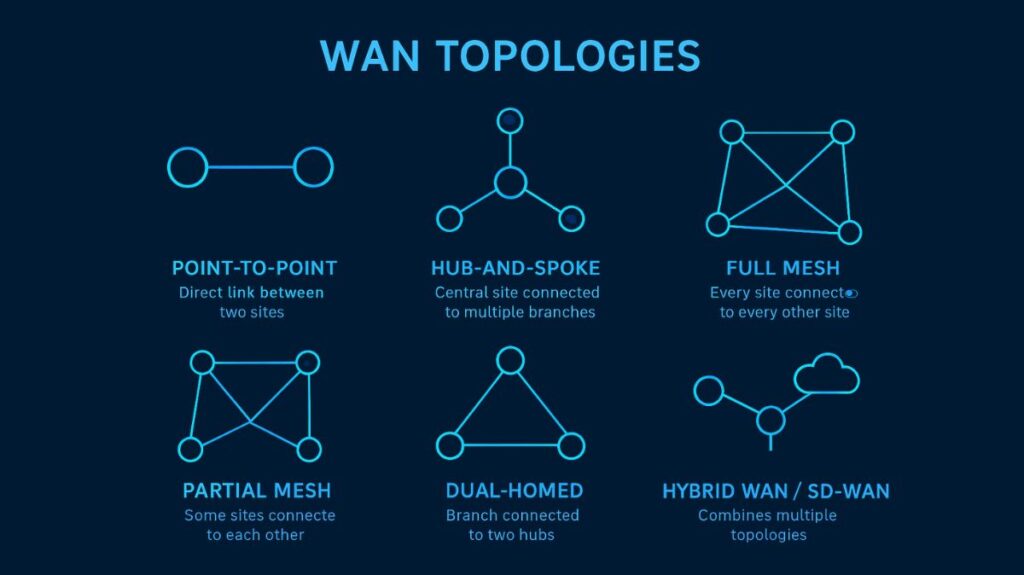
The most common WAN topologies include point-to-point, hub-and-spoke, and mesh.
You can also read What is Point to Point Topology Network, Pros and Cons
Point to Point Wan Topology
The most straightforward arrangement is point-to-point (P2P), which involves a direct, dedicated connection between just two locations.
- What it is: A leased line is frequently used to create a direct, dedicated link between two endpoints.
- Mechanism: P2P is a direct connection that gives two routers a single communication channel. The link can be logical (for example, a circuit inside a Frame Relay network connecting two routers miles apart) or physical (for example, a serial cable directly connecting two routers).
- Implementations: Dedicated leased lines, such as T1/E1, are commonly utilized with this topology. Examples from the present day include:
- Dedicated Links/Leased Lines: Often called leased lines or dedicated connections, each remote network has a permanent, set path.
- Ethernet Line Service (E-Line): MEF defines this Metro Ethernet service as a point-to-point connection that functions similarly to a leased line and enables the exchange of Ethernet frames between two customer premise equipment (CPE) devices.
- IPsec: Point-to-point topologies are frequently used in single site-to-site VPN connections.
- Routing: P2P setups do not require Backup Designated Routers (BDRs) or OSPF Designated Routers (DRs).
Hub and Spoke Wan Topology
Several distant “spoke” sites are directly connected to a central hub site in this configuration. In the context of WAN design, it is often referred to as a star topology.
- What it is: Several distant devices are connected to a single central device. All communications between spokes must go via the central hub because spoke sites are not directly connected.
- Implementations: Businesses with a central data center and several branch offices frequently employ it. This service is referred to as the Ethernet Tree Service (E-Tree) in Metro Ethernet, where the remote sites are called Leaves, and the central site is called Root.
- Pros & Cons: Because security and traffic regulations are managed centrally from the hub, it is economical and makes management easier. Since all traffic must pass via the hub, its primary disadvantage is that it is a single point of failure (if it fails, all spoke communication stops) and can become a performance bottleneck.
You can also read What is AH Authentication Header? Functions and Limitations
Mesh Wan Topology
Known for their excellent reliability and redundant connections between nodes, mesh topologies are frequently saved for network backbones because of their expensive cost.
Full Mesh Wan Topology
Every site in the network is directly connected to every other site in a full mesh topology.
- Structure: Offers all traffic direct routes. The total number of dedicated links needed if $N$ sites are connected is $N(N-1)/2$.
- Pros & Cons: Provides maximum fault tolerance and redundancy, preventing a single point of failure. However, because of the complicated configuration and considerable wiring, it is the most expensive alternative.
- Implementations: By establishing a full mesh topology, the Metro Ethernet service known as Ethernet LAN (E-LAN) enables all connected devices to send frames to one another directly, just like if they were on a single, sizable Ethernet switch. Ideal for situations where high availability is required, like tying together disparate data centers or financial trading floors.
Partial Mesh
Links between some but not all node pairs are connected via a partial mesh.
- Structure: While less important sites may use a hub-and-spoke design to connect to primary sites, only the most important sites are directly connected.
- Pros: This design strikes a balance between cost and redundancy. While avoiding the complexity of a full mesh, it offers superior fault tolerance compared to hub-and-spoke.
- Use Case: Thought to be the most popular design for WANs in large enterprises.
You can also read What Is OpenID Connect, Importance And Benefits Of OIDC
Other WAN Topology Considerations
- Dual-Homed: A topology that provides redundant uplinks and lowers the chance of a single hub failure by connecting a site to two distinct central sites (hubs).
- Ring Topology: Each site is connected to exactly two neighbors in a circular pattern. It is less prone to failure than P2P since traffic can be sent around the ring in the opposite direction if a fault is found.
- Bus/Star Topology: Bus and Ring topologies are less used for WANs nowadays, although Star topology is frequently used interchangeably with Hub-and-Spoke in WAN architecture.
- Hybrid WAN / SD-WAN: This contemporary method optimizes performance and robustness by combining two or more basic topologies (e.g., a partial mesh core with hub-and-spoke branches) and several connectivity types (e.g., MPLS, dedicated lines, and public internet). Many Software-Defined Wide Area Network (SD-WAN) deployments are built on this foundation.
Consider WAN topologies similar to airline flight route design in order to comprehend the variations in redundancy and cost:
- A single, dedicated charter flight between two particular cities is known as a point-to-point trip.
- Hub-and-Every smaller city (spoke) only has flights to the major airport hub (like London Heathrow), so connecting travellers must change planes there.
- A direct flight between every conceivable pair of cities is provided by Full Mesh. This offers the best fallback in the event that a route fails, but it comes at a huge infrastructure expense.
- While less important routes continue to rely on central hubs, a partial mesh ensures that high-traffic routes have numerous direct paths.
You can also read Lightweight Extensible Authentication Protocol LEAP