

In this article, we learn about Cisco Broadband, Broadband Network Definition, Types of Broadband Networks, Uses, and Importance.
Cisco Broadband
A high-speed, always-on internet connection that can send massive volumes of data rapidly is referred to as broadband. “Broad bandwidth” is a word that refers to a wide-bandwidth data transmission that can manage several signals and data kinds at once.
Older, slower dial-up connections (which usually ran at 56 Kbps) were replaced by broadband, revolutionizing internet use.
You can also read Types of WAN Topologies: Bus, Ring, Star, Mesh, and Hybrid
Broadband Network Definition
Broadband is acknowledged as a high-speed type of Internet connection in contemporary utilization as well as a fundamental transmission technique in networking (analogue signaling).
High-Speed Definition: Broadband was once simply described as being quicker than conventional dial-up. Nonetheless, specific minimum speed criteria are provided by the US Federal Communications Commission (FCC):
- Broadband was previously defined by the FCC as having a minimum upload speed of 3 Mbps and a minimum download speed of 25 Mbps (Megabits per second).
- The FCC raised this minimum requirement to 20 Mbps upload and 100 Mbps download in 2024.
- The industry is headed towards gigabit-per-second (Gbps) speeds, and many existing basic service plans now offer rates of 100 Mbps or greater.
Core Features: Compared to prior technologies, broadband connections have several advantages.
- High Speed/Capacity: It can handle large data demands and transport data far more quickly than standard dial-up, allowing several devices and people to use it simultaneously for streaming and gaming.
- Always On: It offers a constant internet connection without requiring the user to “dial in” or connect each time they want to use the internet.
- Reliability: In contrast to earlier technologies, it provides a more reliable connection.
You can also read Hub and Spoke Topology Advantages and Disadvantages
Types of Broadband Networks
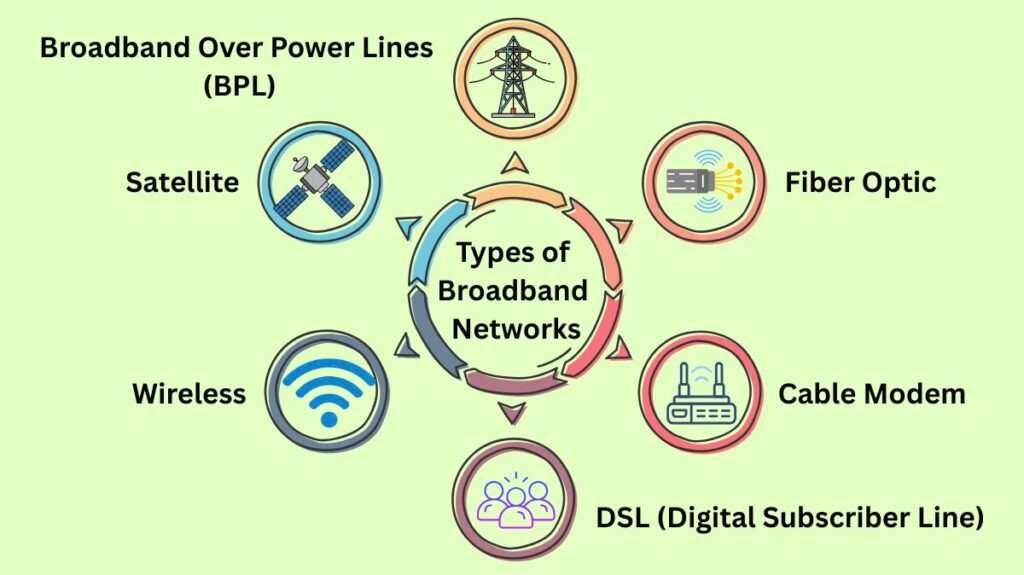
Broadband internet access is delivered through various technologies, classified by the medium they use to transmit data. The most common types include:
| Technology | Medium Used | Key Characteristics |
|---|---|---|
| Fiber Optic | Glass or plastic fibers (transmitting light signals) | The fastest and most reliable option, offering extremely high speeds (up to and beyond 1 Gbps). It is ideal for bandwidth-intensive activities. |
| Cable Modem | Coaxial cable network (same as cable television) | Very fast and widely available, though speeds may slow down during peak usage due to shared bandwidth. Uses a Hybrid Fiber-Coaxial (HFC) network. |
| DSL (Digital Subscriber Line) | Traditional copper telephone lines | Slower than fiber and cable. Speed degrades the farther the user is from the provider’s central office. Types include ADSL (faster download speed) and VDSL (Very-High-Data-Rate). |
| Wireless | Radio waves/signals | Includes fixed wireless access and Mobile Broadband (using cellular networks like 4G and 5G). Used in remote areas where physical lines are unavailable. Wi-Fi is a common example. |
| Satellite | Communication satellites in orbit | Essential for rural or remote areas. Tends to have higher latency (delay) compared to other types and can be affected by weather conditions. |
| Broadband Over Power Lines (BPL) | Existing power lines | Transmits data over electrical systems, offering speeds similar to DSL and cable. |
Uses and Importance
In order to meet the increasing needs of contemporary digital applications, broadband connectivity is necessary. It enables both individuals and companies to carry out a range of data-intensive tasks with ease:
- Entertainment: Facilitates internet gaming and the streaming of high-quality music and video.
- Productivity: Offers quicker access to cloud services, research tools, and internet resources.
- Communication: Makes voice over IP (VoIP) phone calls and video conferences dependable and clear.
- Convenience: Facilitates the simultaneous execution of data-intensive tasks by numerous devices.
Governments and end users alike favor broadband access, which is essential for economic growth, healthcare, and education.
In contrast to prior dial-up connections, which were more like a tiny, single-track road that you had to physically open before you could drive on, broadband functions as a huge, multi-lane digital highway. This highway topology supports the massive traffic demands of contemporary internet usage by enabling simultaneous and fast transmission of sound, video, and data.
You can also read What is Point to Point Topology Network, Pros and Cons