

What is Message Switching?
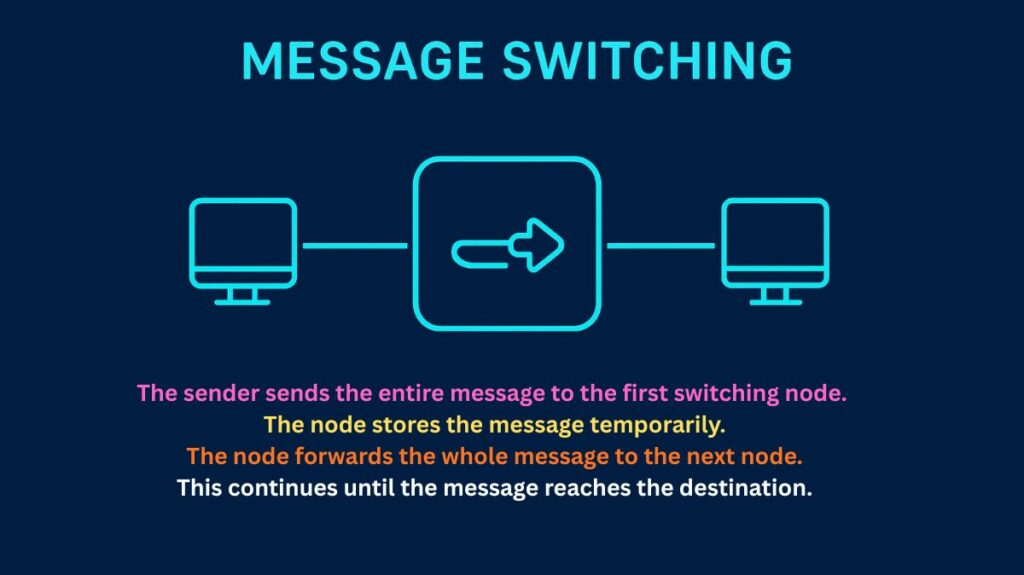
A full message is sent as a single unit, stored at each intermediate node, and then passed to the next hop until it reaches its destination in a network communication technique known as message switching. It handles the entire message at once, unlike packet switching, and it doesn’t need a dedicated path like circuit switching requires. Depending on the destination address of the message, dynamic routing is possible using this “store and forward” technique.
The store-and-forward technique is the fundamental feature of message switching.
You can also read Types of Broadband Networks, Definition, Uses, & Importance
How it Works
When using message switching, the data is transmitted over the network as a single, comprehensive unit known as the “message.”
- Preparation and Transmission: The sender node adds the destination address to the message’s header along with standard routing details like the source, expiration time, and priority level. After that, the first intermediate switching node receives the whole message.
- Store: Before any forwarding can occur, the message must be received and fully stored at the intermediary node. Because of RAM constraints, this storing frequently took place on a hard drive.
- Inspect and Queue: Using its routing table, the intermediate node decides the next hop after inspecting the destination address and looking for transmission faults.
- Forward (Delay System): The message is not deleted if the necessary outgoing circuit or route is congested or network resources are exhausted. Rather, it is kept indefinitely until the required link becomes available in a queue for that route. The message is sent to the following switch once the link is operational.
- Repeat: Until the message reaches its destination, this store-and-forward procedure is repeated at each node.
Key Characteristics
- Connectionless: A dedicated, pre-established path between the sender and the recipient is not necessary for message switching.
- Dynamic Routing: With dynamic routing, messages can travel in a variety of ways to reach their destination because the path is not defined and is decided at each hop based on network conditions.
- Unlimited Message Size: The block size of the message that can be sent is often unlimited. However, a message is strictly discarded if its size exceeds a switch’s storage capacity.
- Location: The entire message is only present in one network place at a time.
- Language: ASCII, Baudot, and Morse are among the computer languages used in message switching.
You can also read Advantages, Types, and Characteristics of Circuit Switching
Message Switching Advantages and Disadvantages
Message switching offers distinct advantages and disadvantages due to its store-and-forward nature:
| Feature | Advantages (Pros) | Disadvantages (Cons) |
|---|---|---|
| Bandwidth/Channels | Efficient channel/bandwidth usage because multiple messages share the same communication lines. | Less efficient for short, frequent messages compared to packet switching. |
| Congestion & Reliability | Reduces network congestion because it can store messages when the channel is busy. | Communication is less reliable because there is no direct relationship or dedicated path between the sender and receiver. |
| Delay | Messages can be stored indefinitely until resources are free. | Slow and unsuitable for real-time applications (like voice or video) due to the delay caused by storing and processing the full message at every hop. |
| Storage | Messages of unlimited size can be sent. | Requires large storage capacity at every intermediate node to hold entire messages. |
| Other | Allows for broadcasting messages with less bandwidth than circuit switching. | High processing overhead since the switch must process the full message header and check for errors at every hop. |
History and Current Use
Message switching preceded packet switching and was created as a substitute for circuit switching.
- In the 1950s, Western Union processed telegrams using a message switching mechanism known as Plan 55-A.
- Although Larry Roberts eventually added packet switching to the architecture, Wesley Clark’s 1967 proposal for the ARPANET was for a message switching network.
- Examples include hop-by-hop Telex forwarding and UUCP (UNIX-to-UNIX Copy Protocol).
- Even though message switching has mostly been replaced by packet switching in data communications, it is still utilized today in a variety of applications, including satellite communications networks, military networks, ad hoc sensor networks, and electronic mail systems.
Message switching can be compared to sending a full physical letter or telegram: before the clerk can read the destination address, determine what to do next, and put the entire letter in a queue for the next leg of its journey, the entire item must be received and stored at the post office (intermediate node). The letter remains in storage forever if the following delivery route is congested.
You can also read Hub and Spoke Topology Advantages and Disadvantages