

OSPFv3 Cisco
A link-state inner gateway routing protocol called Open Shortest Path First version 3 (OSPFv3) was created to accommodate both the IPv6 and IPv4 address families. It is described in RFC 5340. By separating IP addressing from the network topology, OSPFv3 provides a noteworthy architectural change, even if it keeps the core Dijkstra Shortest Path First (SPF) algorithm from OSPFv2.
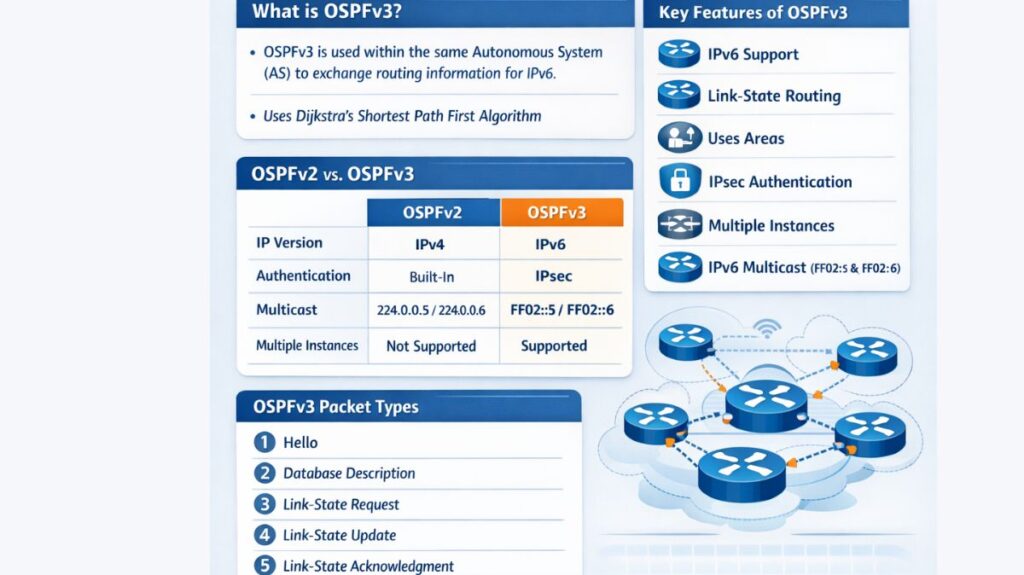
Key Architectural Differences from OSPFv2
With OSPFv3’s redesign to accommodate IPv6’s special requirements, several fundamental functional changes resulted:
- Protocol Independence: OSPFv3 extracts IP prefix information from hello packets and topology-based LSAs, in contrast to OSPFv2, which incorporated prefixes in Type 1 and Type 2 LSAs. By doing this, the protocol is made more efficient by preventing a complete SPF recalculation in response to a prefix modification.
- Adjacencies and Next-Hops: In OSPFv3, adjacencies are configured per-link instead of per-subnet. As the next-hop address for routing updates and for neighbor discovery, OSPFv3 also makes use of IPv6 link-local addresses.
- Security: OSPFv3 is completely dependent on IPsec (AH or ESP headers) for encryption and security purposes; it lacks an internal authentication mechanism.
- Multi-Instance Support: This feature enables more adaptable, multi-tenant network designs by supporting numerous OSPFv3 instances on a single physical link.
- Router ID: In contrast to OSPFv2, the Router ID is still a 32-bit value, but it frequently needs to be manually defined because IPv6 routers may not have IPv4 addresses.
You can also read Importance Of Computer Network Security Protect Your Data
LSA Types and Flooding Scopes
OSPFv3 expands and reinterprets Link State Advertisements (LSAs) to distinguish reachability from topology. Moreover, it presents the explicit flooding scopes of region (inside a region), connection-local (local connection only), and AS (entire autonomous system).
- Type 1 (Device LSA): Describes a router’s link state and costs within an area but contains no address information.
- Type 2 (Network LSA): Generated by the Designated Router (DR) to describe all routers on a broadcast or NBMA segment; it is also protocol-independent.
- Type 3 (Inter-Area Prefix LSA): Renamed from OSPFv2’s “Summary LSA,” it advertises internal networks to other areas.
- Type 4 (Inter-Area Router LSA): Renamed from “ASBR Summary LSA,” it advertises the location of an Autonomous System Boundary Router (ASBR).
- Type 5 (AS External LSA): Used to redistribute routes from other routing protocols or systems into the OSPFv3 domain.
- Type 8 (Link LSA): A new LSA with a link-local scope that advertises the router’s link-local address and a list of IPv6 prefixes associated with that specific link.
- Type 9 (Intra-Area Prefix LSA): A new LSA used to carry IPv6 prefix information for a router or transit network that was previously carried in Type 1 and 2 LSAs.
How it works
- Neighbor Discovery: OSPFv3 employs the Hello protocol for neighbor discovery. In broadcast and non-broadcast multi-access (NBMA) networks, it minimizes LSA flooding by selecting a designated router (DR) and backup designated router (BDR) according to priority (highest priority wins; Router ID is the tie-breaker).
- Communication:
FF02::5is the IPv6 multicast address used by all OSPF routers andFF02::6is the IPv6 multicast address used by all DRs/BDRs. - Cost Calculation: The cost calculation is based on a reference bandwidth, which is 100 Mbps by default. For example, the cost of a T1 link is 64, whereas the baseline cost of a 10 Mbps Ethernet link is 10.
- Load Balancing: OSPFv3 automatically installs additional pathways of equal cost into the routing table, providing a default maximum of 32 paths, in order to achieve load balancing.
You can also read Proxy Firewall vs Packet Filtering, Types of Proxy Firewalls
Configuration and Management
The global process level of OSPFv3 configuration has been replaced by the interface level. In order to directly activate OSPFv3 for a particular region and address family, a user often first defines the routing process and its 32-bit Router ID globally before switching to interface configuration mode. It is not possible to selectively exclude individual prefixes in OSPFv3, unlike OSPFv2, which imports all prefixes on an interface by default if a router has multiple addresses on it.