

What is Point To Multipoint Topology?
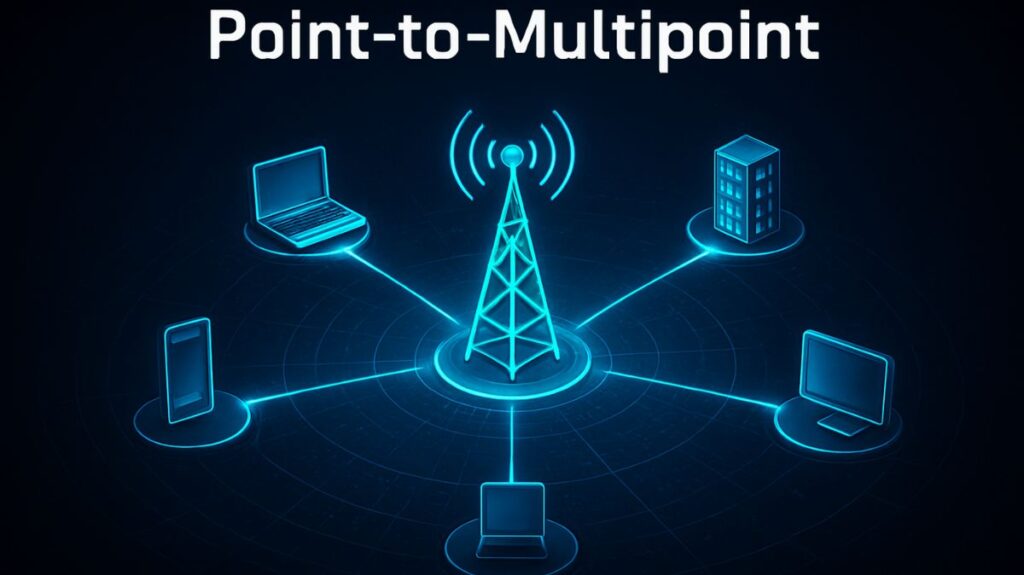
A one-to-many communication model defines the basic, hierarchical Point-to-Multipoint (P2MP or PTMP) network structure. Several peripheral nodes are connected to and communicate with a single central node in this system.
Because of its effectiveness in dispersing connectivity over a large region, this topology is frequently utilized in dispersed communication systems, wireless networks, and service provider networks.
You can also read What Is OpenID Connect, Importance And Benefits Of OIDC
Core Architecture and Relationships
P2MP and the Hub-and-Spoke architecture are fundamentally identical. It can alternatively be called a Partial Mesh design or have a close relationship to one. Any topology including more than two devices is referred to as “multipoint.”
Key Components:
- Root/Base Station (The “Point”): The one central device that transmits and receives data for the whole network is called the Root/Base Station, or “Point.” A strong router, an access point (AP), or an optical line terminal (OLT) are a few examples.
- Leaf/Subscriber Units (The “Multipoint”): The numerous distant devices or clients that link back to the Root are known as Leaf/Subscriber Units, or the “Multipoint.” They are frequently branch offices, customer residences, Customer Premises Equipment (CPE), or Optical Network Units (ONUs).
- Shared Medium: All Leaf stations share the communication link, which may be a single fiber-optic cable with splitters or a radio frequency spectrum.
Communication Flow:
All peripheral nodes can receive data broadcasts from the central node downstream. Data can be sent upstream from any peripheral node to the central node. One distinguishing feature is that the central node usually serves as the conduit for communication between the periphery nodes. Typically, every interface that shares a P2MP connection is part of the same network.
The P2MP architecture functions similarly to a radio broadcast station (the single transmitter/hub), transmitting signals to several separate receivers (the spokes); the receivers are unable to speak with one another directly.
Point To Multipoint Topology Advantages and Disadvantages
| Feature | Advantage | Disadvantage |
|---|---|---|
| Cost & Efficiency | Highly cost-effective for a large number of users or sites, reducing equipment and fiber/cable use compared to dedicated Point-to-Point (P2P) links. | Shared bandwidth means performance for any single user can drop significantly as more users access the network. |
| Scalability & Management | Easy to scale; adding a new peripheral node requires minimal infrastructure changes at the central Root station. Centralized management and security simplifies operation. | Single Point of Failure; if the central Root/Base Station fails, the entire network connected to it is disrupted. |
| Performance | Efficient for covering many devices from a single point. | Increased latency for peer-to-peer (Spoke-to-Spoke) communication, as data must travel two hops (Spoke $\to$ Root $\to$ Spoke). The central point can become congested. |
You can also read Lightweight Extensible Authentication Protocol LEAP
Implementations and Common Uses
P2MP is essential to several networking technologies and is frequently used for effective bulk bandwidth distribution:
Wireless and Broadcast Applications
- Wireless Internet Service Providers (WISPs): Fixed wireless broadband is transmitted to several residences and businesses (Leaves) via a central tower equipped with sector antennas (Root).
- Antennas: Directional antennas pointed towards the central point are used at faraway locations, whereas omnidirectional antennas are usually used near the central site.
- Broadcasting: This one-to-many communication style is exemplified by radio and television broadcasting.
- CCTV surveillance systems, smart buildings, and smart metering are further applications. Line-of-sight is frequently necessary for wireless technologies.
Fiber Networks
Passive Optical Network (PON): Used in Fiber to the Home (FTTH), PON systems use a P2MP design, which allows for significant cost effectiveness by passively splitting a single fiber from the central office to serve dozens of subscribers.
Wide Area Networks (WAN) and Protocols
Technologies such as Frame Relay and MPLS rely on the P2MP concept.
- Frame Relay: Establishes several Permanent Virtual Circuits (PVCs) to several distant routers that share the same subnet by using a multipoint subinterface.
- Metro Ethernet (E-Tree): The Ethernet Tree Service specifically establishes a P2MP WAN topology in which distant sites are leaves and the central site is the root. In particular, direct communication between distant sites is prohibited.
- Dynamic Multipoint VPN (DMVPN): Cisco’s Dynamic Multipoint VPN (DMVPN) technology makes use of the hub-and-spoke arrangement. Multiple IPsec tunnels can be dynamically supported by a single GRE interface, the hub router’s use of Multipoint Generic Routing Encapsulation (mGRE).
OSPF Routing Protocol
Frequently utilized when several routers are connected in a hub-and-spoke configuration over a Non-Broadcast Multi-Access (NBMA) network, the Open Shortest Path First (OSPF) routing protocol specifies a particular network type for P2MP.
- Standard P2MP: There is no election for a designated router (DR) or backup designated router (BDR) in the standard OSPF Point-to-Multipoint network type (broadcast mode). For dynamic neighbor discovery, OSPF traffic is frequently broadcast to the address 224.0.0.5.
- Non-Broadcast Variation: Since multicast cannot be used for dynamic discovery, the Point-to-Multipoint Non-Broadcast configuration necessitates static OSPF neighbor setup.
You can also read What is Single Sign On SSO, How it Works and Purpose