

In this article, we learn about what Authentication Protocol is, the General Principles of Network Authentication Protocols, Types of Authentication Protocols, and Emerging Technologies.
What is an Authentication Protocol
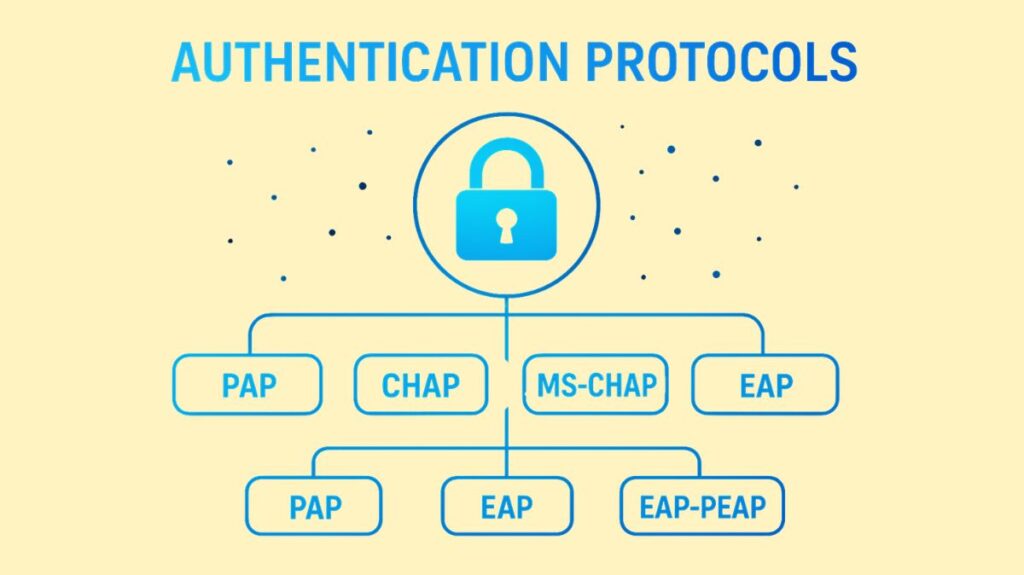
Authentication protocols (APs) are specific kinds of cryptographic or computer communications protocols that are primarily made for the exchange of authentication information between two parties. Because their main function is to confirm the identity of a person, process, or device before allowing access to network resources or data, these protocols are crucial for network security.
APs specify the precise sequence of actions required for authentication to take place. They enable the connecting entity (such as a client) to be authenticated by the receiving entity (such as a server), and occasionally they enable the server to authenticate itself to the client.
You can also read What is Frame Relay Explained, Components and Configuration
General Principles of Network Authentication Protocols
For an Authentication Protocol to function, it must adhere to several principles:
- Two or more people must be involved, and each party must be aware of the etiquette beforehand.
- Everybody participating needs to adhere to the protocol exactly.
- Every step in the protocol must be well stated in order for it to be unambiguous.
- The protocol needs to be comprehensive, with a defined course of action for each potential scenario.
In a very simple example, Alice (the entity that wants to be verified) sends Bob (the entity that is verifying) her password in a packet that complies with the protocol requirements. Bob then transmits a packet indicating “Authentication successful” or “Authentication failed” after comparing the password he got with a database that has been saved. However, most modern protocols are much more complex to ensure resilience because such simple protocols are extremely susceptible to threats like eavesdropping, replay attacks, man-in-the-middle attacks, dictionary attacks, or brute-force attacks.
Types of Authentication Protocols
Authentication protocols are frequently grouped according to the context in which they are used, such as wireless connections, centralized enterprise access, or wide area networks.
Protocols Developed for PPP (Point-to-Point Protocol)
PPP servers mainly use these protocols to verify remote clients’ identities before allowing them access to server data.
- PAP (Password Authentication Protocol): One of the earliest authentication protocols is PAP (Password Authentication Protocol).
- A two-way handshake is used.
- Because the credentials (password and username) are sent “in the clear” (plain text) and frequently, making it susceptible to basic attacks like eavesdropping, it is regarded as extremely insecure.
- Usually, authentication is only done when the link is first established.
- CHAP (Challenge-Handshake Authentication Protocol): The preferred and safer PPP authentication method is called CHAP (Challenge-Handshake Authentication Protocol).
- A three-way handshake is used.
- The server or host starts the authentication process, which can be carried out multiple times throughout the session.
- A random string (a challenge) is sent by the server. This string and the password are fed into a hash function by the client, which then returns the hash value.
- By ensuring that the password is never sent in plain text, this procedure guards against playback attacks.
- MS-CHAP v2 is an upgraded Microsoft version that provides mutual authentication (client and server check each other) and employs stronger hashing.
- EAP (Extensible Authentication Protocol): EAP is a broad authentication framework rather than a specific protocol.
- Although it was initially created for PPP, it is currently commonly used in settings such as IEEE 802.11 (Wi-Fi) as a component of the authentication framework for IEEE 802.1x.
- EAP allows several authentication mechanisms (called EAP-methods), such as certificates, smart cards, biometrics, or one-time passwords.
- Examples include PEAP (Protected EAP, frequently used in enterprise Wi-Fi) and EAP-TLS (most secure, requiring digital certificates on both ends).
You can also read Cisco Software Defined Networking and How SD-WAN Works
AAA Architecture Protocols
These complex protocols are typically used in larger networks for Authentication, Authorization, and Accounting (AAA).
- RADIUS (Remote Authentication Dial-In User Service):
- The industry standard for network access, such as 802.1X Wi-Fi, ISPs, and VPNs, is a complete AAA protocol.
- The client/server model is how it functions.
- The UDP transport protocol is used by RADIUS.
- Only the password field transmitted between the server and the network device is known to be encrypted.
- TACACS+ (Terminal Access Controller Access Control System Plus):
- A proprietary protocol from Cisco.
- The dependable TCP transport protocol is used.
- TACACS+ is much more secure than RADIUS since it encrypts every packet that travels between the client and the server.
- Additionally, it offers more precise command-level management by separating the Accounting, Authorization, and Authentication processes.
- DIAMETER: This protocol, which was developed from RADIUS, includes enhancements, including the use of more dependable TCP or SCTP transport protocols and improved security because of TLS (Transport Layer Security).
Enterprise and System Access Protocols
- Kerberos: The default authentication technique in Windows 2000 and later is Kerberos, a centralized network authentication system created at MIT.
- It makes use of symmetric key cryptography and depends on the Key Distribution Centre (KDC), a reliable third party.
- In order to offer mutual authentication between a client and a server and avoid sending passwords directly over the network, it uses a system of “tickets.”
- SAML (Security Assertion Markup Language): Security Assertion Markup Language, or SAML, is an open standard based on XML that makes Single Sign-On (SSO) easier. It enables the transmission of authorization and authentication information to a Service Provider (SP) via an Identity Provider (IdP).
- OpenID Connect (OIDC): The OAuth 2.0 authorization framework serves as the foundation for the identity verification layer known as OpenID Connect (OIDC).
Emerging Technologies
The Industrial Internet of Things (IIoT) and other resource-constrained contexts are the main focus of current authentication protocol research. Among these developments are:
- Employing cutting-edge cryptographic methods, such as Elliptic Curve Cryptography (ECC), to reduce energy and computational overhead while facilitating session key negotiation and safe mutual authentication.
- Combining biometric authentication with privacy-preserving techniques.
- Emphasis on maintaining forward and backward secrecy to safeguard session keys and thwarting side-channel and replay attacks.
Authentication protocols function similarly to a vault’s multi-layered security system. Because credentials are delivered in plain text, basic methods like PAP are like a simple lock that is readily picked. In order to prevent eavesdropping and replay attacks, PPP protocols such as CHAP add a rotating security code (the hash challenge) after a badge swipe and keypad entry. A central server (RADIUS/TACACS+) that can manage sophisticated techniques, such as highly trustworthy digital certificates, receives identity checks from enterprise protocols like EAP frameworks linked with 802.1X.
You can also read Hypertext Transfer Protocol HTTP and Evolution of HTTP