

Dual Homed Topology
The main purpose of a dual-homed topology in network design is to offer redundancy and fault tolerance. By removing single points of failure, this configuration guarantees network resilience.
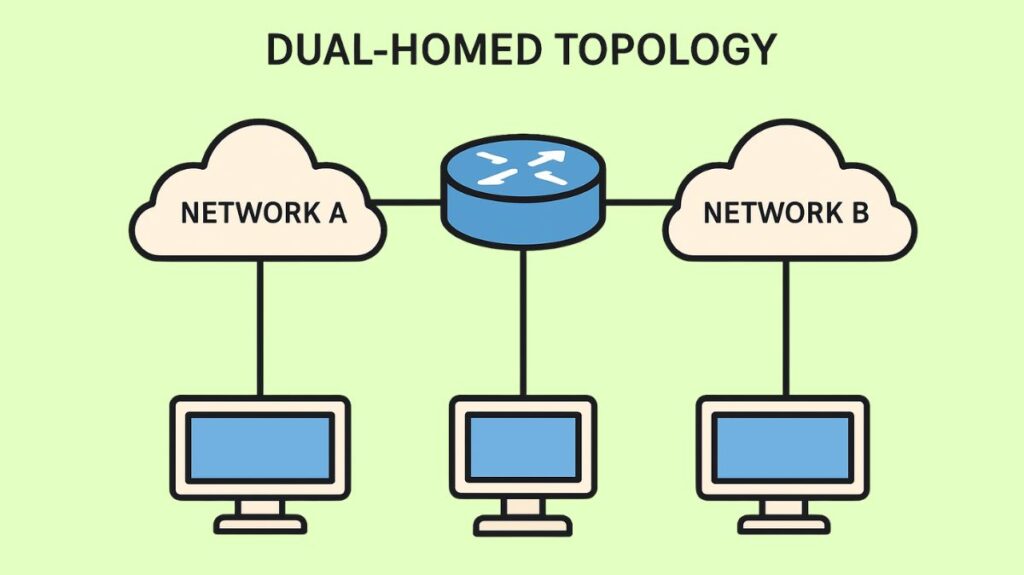
Core Definition and Mechanism
Dual homing is a topology in which two independent access points (points of attachment) or two distinct upstream devices are used to join a single network device, host, server, or even an entire network segment to the network at the same time.
Key characteristics of a dual-homed device or topology include:
- Two Interfaces: Two network interfaces, such as two Network Interface Cards, or NICs, are required for the device. Usually, every interface is located in a separate network.
- Redundant Connections: The design makes sure that network traffic has a fallback route. The other connection or link stays active even if the first one fails.
- Connectivity Modes: There are various configurations for the two links:
- Active/Passive (or Active/Standby): The primary connection is made by one access point, while the standby connection is only triggered in the event that the primary link fails.
- Active/Active (Load Sharing): Both connections are utilized at the same time, enabling load balancing to divide traffic and potentially increase network capacity and performance.
You can also read What is Point To Multipoint Topology Advantages, Common Uses
Purposes and Applications
The primary objective of using a dual-homed topology is to maintain continuous connectivity and high availability.
| Feature | Description | Contexts/Examples |
|---|---|---|
| Redundancy & Reliability | Provides a backup path, ensuring uptime if one connection fails. It achieves redundancy for what would otherwise be a single-homed topology. | Used commonly on the WAN of enterprises to ensure customers and partners can always access resources. |
| Fault Tolerance | Supports quick switchover if a link or device fails. | A dual-homed station is attached to multiple Fiber Distributed Data Interface (FDDI) concentrators specifically to provide redundancy. |
| High Availability | Used in high-availability setups and secure networks. | Servers connected to two different switches to avoid a single point of failure within a Local Area Network (LAN). |
| Security | Used in firewall and DMZ configurations. A dual-homed firewall sits between a trusted network (e.g., corporate LAN) and an untrusted network (e.g., the internet), equipped with two network interfaces and configured to not unconditionally forward IP datagrams. |
You can also read What is Diameter protocol Explained, Applications & Commands
Contexts of Dual Homing
Dual homing is primarily recognized in two contexts:
- External Connectivity (ISP Connection): A business uses two different routers or connections to the same Internet Service Provider (ISP) to link its corporate network to the public internet. Redundancy against equipment and link failure is provided by this configuration.
- Internal Connectivity (Device/Host): Two Network Interface Controllers (NICs) are used by an endpoint device, like a server or switch, and are connected to two distinct upstream switches or routers. For a resilient architecture, a spoke VNet can be dual-homed to two different hub VNets in cloud environments.
Comparison and Caveats
While dual-homing offers robust resilience, it is often considered an intermediate solution compared to other topologies:
- Single-Homed: Because there is only one link connecting the site, there is a single point of failure.
- Dual-Homed (One ISP): High redundancy against equipment failure is provided by dual-homed (one ISP) systems, although they are still susceptible to an outage affecting the entire ISP network.
- Multi-Homed: Connecting to two or more separate, independent ISPs is necessary for multi-homing, which offers extremely high redundancy against failures of the link, device, and ISP network.
Dual-homing has drawbacks, such as the need for additional hardware and cabling, which raises costs. Furthermore, the setup and upkeep are more complicated, requiring knowledgeable network administration to set up load balancing and failover correctly. If internal redundancy is not maintained, improper configuration may even cause the network to break into two distinct networks.
By reducing the likelihood of a single point of failure locking you out of your network access, the dual-homed design essentially functions like having two keys to a door: if the first one breaks, you have the second one ready right away.
You can also read What is EAP AKA, How it Works, Advantages and Disadvantages