

Metro Ethernet Explained
A high-speed networking service called Metro Ethernet (MetroE) connects several customer locations inside a Metropolitan Area Network (MAN), which usually covers a city or sizable urban area, using Ethernet standards. In essence, it spreads a Local Area Network’s (LAN) ease of use, affordability, and high-bandwidth capabilities throughout a metropolitan area.
Ethernet MAN, Business Ethernet, Ethernet over Fiber (EoF), Carrier Ethernet (the more general term established by the Metro Ethernet Forum, MEF), and Ethernet WAN are frequently used interchangeably with Metro Ethernet.
You can also read What is Message Switching & advantages of message switching
How Metro Ethernet Works
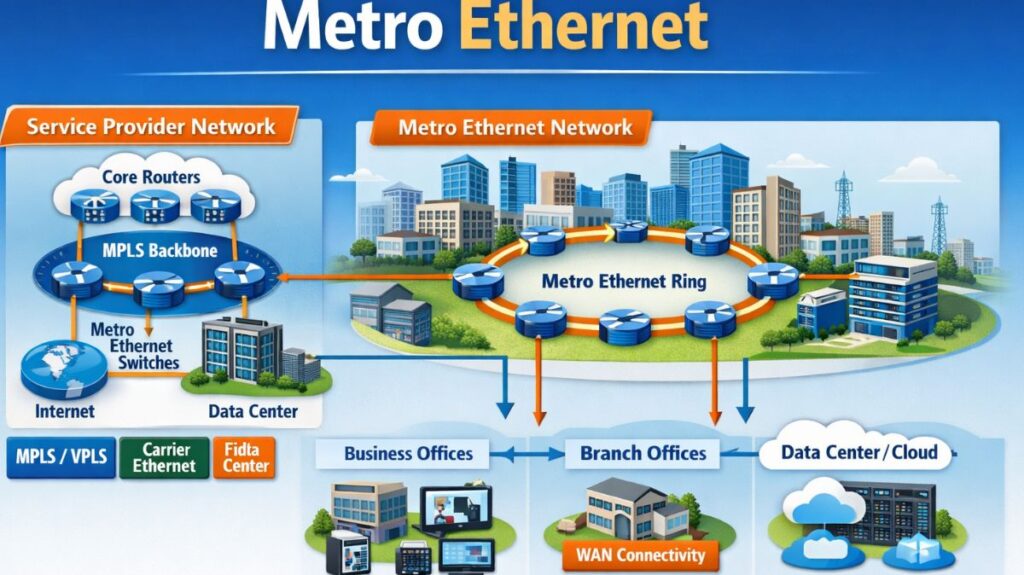
Connecting geographically dispersed offices and data centers so they function as though they were on the same local network is the purpose of metro Ethernet, a private, carrier-grade service.
- Layer 2 Functionality: According to the OSI model, Metro Ethernet mostly functions at Layer 2, or the Data Link Layer. From the standpoint of the client, the service functions theoretically as a single, massive Ethernet switch that covers the entire city. Transparent Ethernet frame forwarding between client locations is the responsibility of the service provider (SP).
- Technology: To achieve high speeds and minimal latency, it mostly uses fiber-optic lines.
- Speed and Distance: Metro Ethernet standards currently allow for speeds of up to 100 kilometers (62 miles), whereas Ethernet was formerly restricted by distance. 10 Mbps, 10 Gbps, and even 100 Gbps are among the speeds it can support.
- Customer Interface: Companies can connect their current Ethernet equipment (firewalls, switches, and routers) using standard Ethernet interfaces (such as RJ-45 or SFP) without the need for proprietary or specialized Wide Area Network (WAN) hardware. The access link, which connects through the User Network Interface (UNI), is the physical connection that ties the client device to the SP network.
- Provider Infrastructure: The SP makes use of fast Ethernet switches situated at Points of Presence (PoP) establishments. Ethernet frames may be sent across the core network internally by the provider network using underlying technologies like Multiprotocol Label Switching (MPLS), often known as Ethernet over MPLS.
- Performance Guarantees: This carrier-grade service provides redundancy, a Service Level Agreement (SLA), and guaranteed performance. The Committed Information Rate (CIR), the lowest bandwidth the SP promises to provide via the service, is used to control performance.
You can also read Lightweight Extensible Authentication Protocol LEAP
Metro Ethernet Service Types
The Metro Ethernet Forum (MEF) defines standardized services categorized by their topology. These connections are known as Ethernet Virtual Connections (EVCs), which define which customer devices are permitted to communicate.
| Service Type | Short Name | Topology | Description |
|---|---|---|---|
| Ethernet Line Service | E-Line | Point-to-Point (P2P) | Connects two sites securely and directly (e.g., HQ to Data Center), acting like a virtual leased line. Variations include Ethernet Private Line (EPL) and Ethernet Virtual Private Line (EVPL). E-Line is also known as Virtual Private Wire Service (VPWS). |
| Ethernet LAN Service | E-LAN | Multipoint-to-Multipoint (MP2MP) or Full Mesh | Connects multiple sites, allowing any-to-any communication, thereby creating a unified LAN across all branch offices. All links generally lie within the same subnet. E-LAN is also known as Virtual Private LAN Service (VPLS). |
| Ethernet Tree Service | E-Tree | Root-to-Leaf (Hub-and-Spoke) or Partial Mesh | Connects a central “root” site (like HQ) to multiple “leaf” sites (like branches). The leaf sites can only communicate with the root, not directly with each other. |
Key Advantages and Use Cases
Metro Ethernet has several advantages over more antiquated technologies like T1/E1 lines, making it the recommended WAN option, especially for intra-city connectivity:
- High Bandwidth and Scalability: It can be swiftly scaled up and readily supports high speeds, frequently with little software configuration adjustments that don’t require significant hardware replacement.
- Cost-Effectiveness: Compared to proprietary or outdated leased line technology, it is usually more affordable for large bandwidth requirements.
- Low Latency: For real-time applications like VoIP and video conferencing, very low, constant latency is achieved by the fiber-optic, high-speed, and streamlined Layer 2 design. Symmetrical internet speeds, or equal upload and download speeds, are typically offered by Metro Ethernet.
- Security: Since most traffic does not travel over the public internet, sites are naturally isolated from one another. Security features like DDoS protection and VLAN segmentation can be implemented by providers.
- Familiarity: It makes configuration and troubleshooting easier for IT teams because it utilizes the same Ethernet technology that is currently used in the LAN.
Common Use Cases for Metro Ethernet include:
- Office Interconnection: Office interconnection is the process of smoothly joining a business’s main office, satellite offices, and production facilities in the same city.
- Data Center Interconnect (DCI): Providing links between primary and disaster recovery locations that are incredibly fast and low-latency.
- Cloud Access: Offering a specialized, safe, and quick connection route to cloud service providers is known as cloud access.
It is comparable to using a trusted set of keys (Ethernet framing) to unlock doors (sites) throughout a city, with the service provider’s invisible transportation system (fiber/MPLS backbone) handling the long distances between those locks. This is how Metro Ethernet can span large distances while maintaining the familiar Ethernet framing and addressing scheme.
You can also read Benefits of SAML Security Assertion Markup Language