

What is Point to Point Topology?
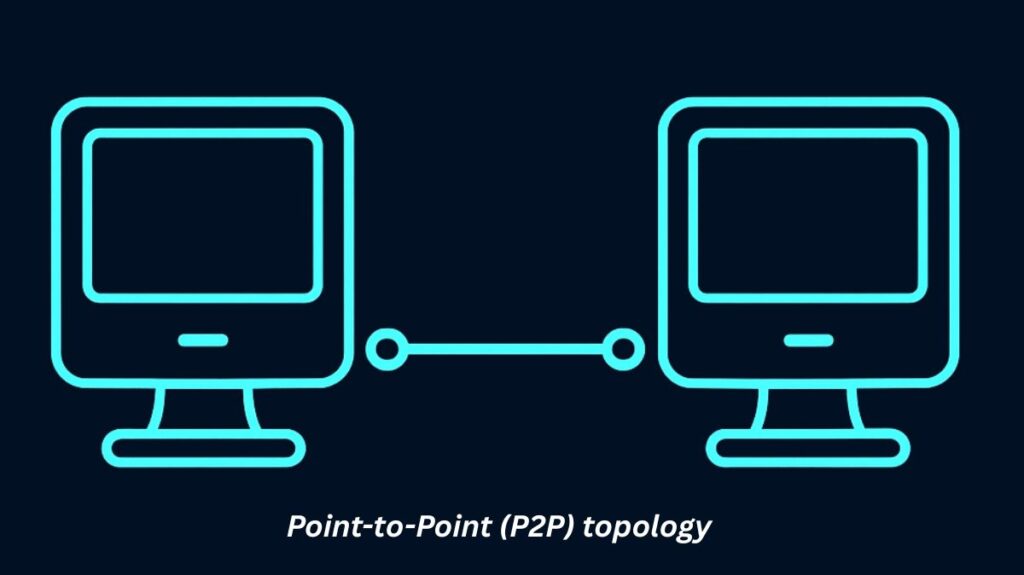
A network arrangement known as a point-to-point (P2P) topology establishes a dedicated, direct communication channel between two nodes, like two routers or two PCs. Because there are no intermediary devices involved, this dedicated connection offers fast speed, low latency, and stability. P2P is easy to use and efficient for two endpoints, but it is inefficient for large-scale networks because every new device needs its own dedicated link.
You can also read What is AH Authentication Header? Functions and Limitations
Point to Point Topology Definition
A communications link is created between precisely two communication endpoints, or nodes, in a point-to-point network.
- Two Nodes: Two hosts, such as PCs, switches, routers, or servers, are connected back-to-back in P2P networks. A configuration with two and only two devices that can communicate directly with one another is referred to as point-to-point.
- Dedicated Link: There is just one dedicated link connecting the two nodes. This dedicated connection guarantees that all of the link’s capacity or bandwidth is set up just for transmission between these two particular endpoints. The connection is unshared and private.
- Direct Communication: No intermediary devices or other network nodes are involved in the data transfer between the two endpoints. The two main components of this communication are transmit and receive. Usually, the transmitting end of one host is connected to the receiving end of another, and vice versa.
- Implementation: The link may be a wireless connection (using laser or microwave technologies) or a physical cable (such as Ethernet or fiber optics). The connection can be logical, like two routers connected via a circuit in a network like Frame Relay, or physical, like two routers physically connected by a serial cable.
The end hosts are not aware of the underlying network and perceive each other as directly connected, even if a P2P link may contain several intermediate devices if they are logically connected.
You can also read What is Kerberos, Limitations of Kerberos and Components
Advantages of Point to Point Topology
P2P topology is valued for its performance and security characteristics, largely due to the dedicated nature of the link:
| Feature | Detail |
|---|---|
| Performance | Offers high bandwidth and high performance because the entire capacity is dedicated, resulting in high speed and no congestion from other devices. |
| Low Latency | Data can travel quickly with minimal delay because there are no shared resources or intermediate hops. |
| Security | Relatively more secure as it does not rely on intermediate devices that can be compromised. Since data does not travel over the public internet, P2P connections (often called private or leased lines) are extremely secure. |
| Reliability | The dedicated connection is very reliable. If one link fails, only the two connected devices are affected. |
| Configuration | Easy to set up and configure, requiring minimal management or administration. Faults are easy to isolate and troubleshoot. |
One source notes that P2P networks can be easy to scale, as they only require additional connections to be added between devices.
Disadvantages of Point to Point Topology
Notwithstanding the advantages, P2P topology is limited in its range of applications:
- Limited Scalability: P2P is ineffective in networks with a lot of users. Since every new device needs a unique, dedicated link, adding new devices is difficult and costly.
- Cost: Because P2P networks need dedicated connections, they may be more costly than other network types. When constructing a multi-site network that must grow over time, they might not be the most affordable choice.
- Lack of Redundancy: Because P2P networks only have one point of connection between the devices, they usually have a low fault tolerance. Communication completely ceases if the dedicated link breaks.
- Maintenance (Complexity): P2P networks can be difficult to maintain as each device has to be managed separately. Furthermore, the physical setup becomes complex if many pairs of devices need to be connected (e.g., a full mesh of $N$ devices requires $N(N-1)/2$ links).
You can also read What is Diameter protocol Explained, Applications & Commands
Applications and Related Technologies
When high security and Quality of Service (QoS) are needed, point-to-point connections are crucial.
- Wide Area Networks (WANs): P2P topology is typically used for wide area network (WAN) links. It offers secure WAN connectivity and is used to link a main office (headquarters) to a branch office.
- Dedicated/Leased Lines: Also known as leased lines or private lines, P2P links are frequently leased from service providers to safely link two data centers or office locations. A fixed and permanent communications channel is offered via dedicated lines.
- VPNs: Common instances of P2P topology include site-to-site VPN connections, such as those made by IPsec or Generic Routing Encapsulation (GRE) tunnels.
- High-Performance Uses: P2P is useful for massive file transfers, secure cloud or data center connections, and supporting applications where speed is crucial, including flawless video streaming.
- Network Protocols: Transporting Layer 3 packets over a P2P link is accomplished by the industry-standard Point-to-Point Protocol (PPP). PPP offers capabilities including dynamic addressing, error control, and authentication. For use with services like DSL, it is encapsulated in Ethernet packets as PPPoE.
- Routing: Using the P2P network type on connections with just two connected routers eliminates the requirement for Designated Routers (DRs) or Backup Designated Routers (BDRs) in routing protocols such as Open Shortest Path First (OSPF), simplifying configuration and speeding up convergence.
A point-to-point topology is similar to a dedicated circuit, or private telephone line, that connects just you and one other person. Because there are only two individuals on the connection, you don’t need a moderator (like an OSPF Designated Router) to oversee turn-taking or a public address book (like ARP or complicated routing methods) to identify who you’re speaking to. For easy two-way communication, the connection is direct, exclusive, and streamlined.