

In this article, we learn about Mesh topology, meaning, Characteristics, Full Mesh Topology, Full Mesh in Design Contexts, Partial Mesh Topology, Partial Mesh in Design Contexts, Operation and Data Transmission, Advantages and Disadvantages of Mesh Topology, and Mesh in Wireless Networks.
Mesh Topology
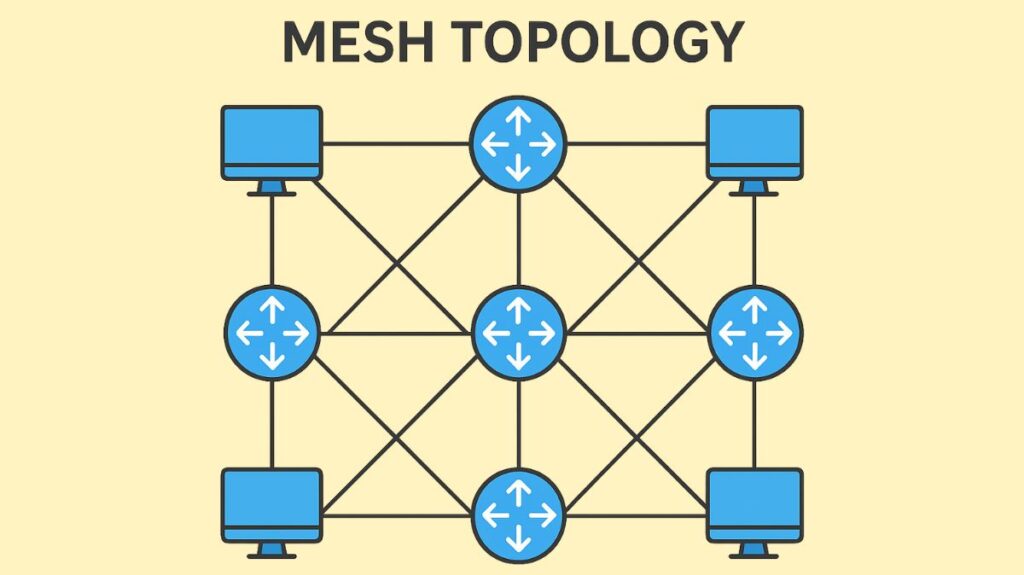
Using numerous interconnected links between devices, the mesh topology is a resilient and adaptable network design that is renowned for its high level of redundancy and fault tolerance. Full Mesh and Partial Mesh are the two primary types of mesh topologies.
Mesh Topology Meaning
Devices are arranged in a controllable, segmented fashion with numerous, frequently redundant, interconnections placed strategically between network nodes in a mesh topology, also known as just “mesh.” It usually provides a path to and from each device on the network, connecting all of the devices together.
Mesh Topology Characteristics
- Redundancy and Reliability: A mesh topology’s main benefit is its increased fault tolerance and dependability as a result of redundant connections. Data will nearly always reach its destination because devices can determine the fastest path to redirect the packet to its destination in the event of a link failure.
- Implementation: Wide Area Networks (WANs) typically employ mesh topologies. Typically, twisted-pair cable or fiber is used to make the physical connection.
- Disadvantages: Because mesh topologies require a lot of wiring, they are typically the most expensive to implement. Their intricate design can also make it exceedingly challenging to pinpoint the precise issue (for example, if a cable piece breaks), which adds to the complexity of management.
You can also read What is Point To Multipoint Topology Advantages, Common Uses
Full Mesh Topology
A full mesh topology provides the most redundancy and connection.
- Definition: A design that establishes a direct link or communication path between every pair of nodes in the network is known as a full mesh. A complete mesh necessitates a link connecting each pair of network nodes.
- Maximum Redundancy: To provide maximum redundancy and fault tolerance, each node is physically or virtually connected to every other node.
- Cost Calculation: The formula N(N – 1) / 2, where N is the number of nodes, can be used to determine the number of links needed for a complete mesh topology. For example, 15 links are used in a full mesh with six switches. 861 links and 1,722 switch ports would be used for a large example with 42 switches (40 access and 2 distribution). For big networks, a full mesh is frequently not feasible due to the high connection needs.
Full Mesh in Design Contexts
- WANs: Every routing node on a packet-switching network has a direct path to every other node when the WAN is completely meshed. This method frequently necessitates a large number of virtual circuits, increasing the cost.
- Metro Ethernet: A full mesh topology is produced by the Ethernet LAN Service (E-LAN), which is described by MEF. By acting as a single LAN, this service enables all linked devices to function on the same Layer 3 subnet and send frames directly to each other.
- LANs: The distribution layer in a three-tier design paradigm is occasionally discussed in terms of being fully meshed for redundancy, but this is typically avoided in campus LANs due to high link counts.
- SDN Underlay: To increase redundancy and improve performance, devices in the Software-Defined Network (SDN) underlay may be cabled using a full mesh topology, but, as the network expands, the number of links may soon become unmanageable.
You can also read Benefits of SAML Security Assertion Markup Language
Partial Mesh Topology
A partial mesh strikes a balance between redundancy and cost/complexity.
- Definition: Any design that creates links between some but not all pairs of nodes is referred to as a partial mesh. This mesh is specifically not complete.
- Function: Compared to a standard hub-and-spoke design, it offers better redundancy while reducing the number of routers that are directly connected to every other router. This architecture, which offers virtual circuits, performance, and redundancy, is thought to be the most balanced.
- Redundancy: If a major route fails, a partial mesh that is not completely meshed nonetheless offers redundancy by providing multiple longer, other routes.
Partial Mesh in Design Contexts
- Campus LANs (Distribution Layer): Usually, a partial mesh of links between the distribution and access switches is implemented by the distribution layer in a two-tier or collapsed core design. A partial mesh of links is frequently employed in the core layer of a three-tier system to enable connectivity with fewer links.
- WAN Topologies: In the context of Frame Relay, partial mesh, often known as a star topology or hub-and-spoke topology, is an alternative for WAN topology.
- Metro Ethernet: The topology concepts partial mesh and point-to-multipoint define the Ethernet Tree Service (E-Tree), which establishes a hub-and-spoke structure. Since distant locations are unable to speak with one another directly, this mesh is only partially functional.
Operation and Data Transmission
A mesh network’s multi-nodal connections make data transport unique.
- Routing: Information moves from node to node, taking the quickest route possible to get there. The network’s routing algorithms choose the optimal route based on variables including link quality, traffic congestion, and distance.
- Protocols: Data in mesh networks can either be routed (following a predefined path) or flooded (flowing continuously until it reaches its destination or the time-to-leave (TTL) expires). Among the most important routing protocols are:
- Reactive (On-Demand): Ad hoc On-Demand Distance Vector (AODV), which only finds routes when data has to be transferred, is an example of a reactive (on-demand) system.
- Proactive (Table-Driven): Similar to Optimized Link State Routing (OLSR), which continuously keeps all nodes’ routes up to date.
- Protocols like IS-IS and OSPF are utilized in wired enterprise networks.
- Self-Healing: The network can automatically reroute traffic over alternate routes in the event that a link breaks or one connection fails, guaranteeing continuous functioning.
You can also read What is Open System Authentication OSA and How it Works?
Advantages and Disadvantages of Mesh Topology
Benefits of Mesh Topology
| Advantages (Pros) | |
| High Reliability/Fault Tolerance | No single point of failure; data can always find an alternative route if a link or node fails. The network is strong enough to use other nodes if one fails. |
| Traffic Handling | Capable of handling heavy traffic because dedicated links allow multiple simultaneous transmissions, minimizing congestion. |
| Scalability | Scalability is straightforward; new devices can be incorporated without disrupting existing connections. |
| Security | Provides high privacy and security; data travels on dedicated or protected paths, making interception more difficult. |
Disadvantages of Mesh Topology

| Disadvantages (Cons) | |
| High Cost | Generally the most costly to implement due to the large number of cabling requirements and network interface ports. |
| Complexity | Complex design makes setup, installation, maintenance, and fault isolation difficult as the number of nodes increases. |
| Strain on Nodes | Each node has a heavier workload since they are required to perform many tasks and serve as routers. |
| Scalability Limit | The exponential increase in required links makes full mesh impractical for very large networks. |
Mesh in Wireless Networks (Mesh Networks)
The phrase “mesh network” particularly describes a wireless architecture that covers a vast region without depending on traditional Ethernet cabling for each Access Point (AP).
- Function: For backhaul connectivity to the wired LAN infrastructure, client traffic is bridged from AP to AP in a wireless mesh architecture, usually in a daisy-chain pattern, utilizing a different wireless channel.
- Routing: To choose the optimal route for backhaul communication across the APs, the mesh network uses its own dynamic routing system.
- Reliability: These mesh networks are incredibly dependable; in the event that one host (AP) fails, its neighbors will immediately provide additional capacity and fault tolerance by finding a different path.
A dense city’s intricate road system is comparable to a network mesh topology. While a full mesh ensures maximum resilience and many fast paths by building a direct, redundant motorway connecting each important interchange (node), it is prohibitively expensive and necessitates massive infrastructure (links). The practical reality is a partial mesh: local roads (less direct links) make up the remaining connections, while dedicated motorways connect several important interchanges. This eliminates the crippling expense of universal, direct links while providing robust redundancy where it’s most needed.
You can also read What is Kerberos, Limitations of Kerberos and Components