

In this article, we learn about what Network Automation Meaning, Definition, how Network Automation works, the Impact of Automation on Network Management, Cisco Automation Solutions, Types of Network Automation, Configuration Management Tools, and the Future of Network Automation.
What is Network Automation Meaning?
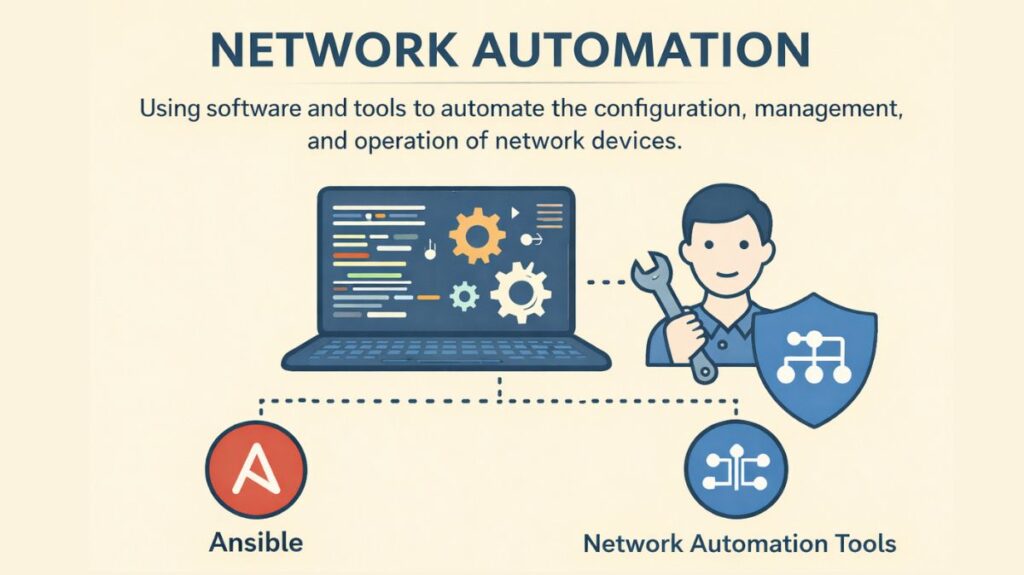
By using software and scripts to automate network device configuration, management, and operation, network automation boosts productivity, lowers error rates, and enhances network dependability. Device provisioning, configuration management, and performance monitoring are among the operations that are performed programmatically rather than by hand. This speeds up the deployment of new services and improves the network’s overall agility while freeing up network administrators to concentrate on higher-level duties like network architecture and security.
It entails automating complicated and repetitive processes on physical and virtual network devices using software tools and pre-established procedures.
You can also read What is MP BGP Multiprotocol BGP? Components and Benefits
Network Automation Definition
The process of automating all physical and virtual device configuration, management, testing, deployment, and operation within a network is known as network automation. Network engineers can now automate these operations by using software, usually written in a language like Python, to set up each device instead of travelling from one to another by hand.
The goals of network automation include:
- Enhanced productivity by drastically cutting down on the time and effort required for provisioning and management chores.
- Increased network stability and consistency by reducing human mistake, which is frequent in manual settings.
- Increased network service availability and dependability.
- Improved scalability to accommodate shifting demands and quicker rollout of new services.
- Enabling network administrators to concentrate on more complex duties like security and network architecture.
This method is frequently referred to by the terms network automation, software-defined networking (SDN), and network programmability interchangeably.
How Does Network Automation Work
Scripts, configuration management software, and specialized automation platforms are commonly used to accomplish automation. Application Programming Interfaces (APIs) are crucial for enabling communication between network devices and software components.
Software-Defined Networking (SDN) Architecture
SDN, which decouples the network planes (data, control, and administration), radically alters conventional network architecture, is centered on network automation.
- Centralized Control: SDN frequently transfers some or all control plane operations (such as executing Spanning Tree Protocol or routing protocols) from separate devices to a centralized SDN controller.
- Interfaces (APIs): This architecture’s communication is organized around two different kinds of APIs:
- Northbound Interfaces (NBIs): These are the interfaces that connect the SDN controller to the applications (such as built-in features in a management tool like Cisco DNA Centre or a bespoke Python program). RESTful APIs (Representational State Transfer), which use HTTP verbs like GET, PUT, and POST to send requests and convey intent to the controller, are frequently used by NBIs.
- Southbound Interfaces (SBIs): The controller and networking equipment (switches and routers) communicate over this interface. NETCONF and RESTCONF are two examples of contemporary SBIs. Older protocols like SSH and SNMP are occasionally used for conventional devices.
You can also read What is Metro Ethernet Network? how does metro ethernet work
Intent-Based Networking (IBN)
Automation frequently makes use of the Intent-Based Networking (IBN) paradigm, in which the network engineer specifies the intended policy or result (intent) as opposed to giving commands unique to a given device. This intent is then automatically translated by the controller into the proper configuration guidelines for each device.
Data Modeling
Configurations are frequently formatted in accordance with standardized data models, like the YANG data model, to provide vendor-agnostic programmability and guarantee consistency. The structure of configuration data, such as interface names, IP addresses, and descriptions, is determined by this model.
- This structured data is usually encoded in JSON (JavaScript Object Notation) or XML (Extensible Markup Language) forms when using RESTCONF.
- Without having to understand the precise syntax for each router’s operating system, YANG data models enable a configuration intent to be applied across several vendors (such as Cisco, Juniper, or HP) that adhere to the model.
Tools and Languages
Many tools and languages are used to implement network automation:
- Python: Because of its ease of use and large library, this programming language is one of the most used in network automation.
- Configuration Management Tools: These tools stop “configuration drift,” or unintentional modifications, and ensure consistent configuration. Chef, Puppet, and Ansible (which is agentless and employs a Push Model) are notable examples.
Impact of Automation on Network Management
Network administration is greatly impacted by automation since it resolves persistent problems:
- Consistency and Error Reduction: Automation produces more streamlined and consistent settings, which reduces errors and the amount of time needed for network troubleshooting. One of the main reasons to use network automation is to reduce human mistakes.
- Operational Models: Instead of concentrating on per-device setup, automation makes it possible to employ new and enhanced operational models that allow configuring the network’s features. Supporting the DevOps networking methodology is part of this.
- Intent-Based Networking (IBN): An IBN model is used by SDN solutions such as SDA and Cisco ACI. The controller automatically determines and applies the required device-specific configurations while the engineer specifies the intended policies or desired outcome (declarative policy model). under contrast, the engineer specifies commands for every protocol on every device under the imperative policy paradigm of traditional networks.
- Advanced Capabilities: The controller can automate complicated tasks that were challenging to accomplish without robust centralized data models. For example, it can provide a Path Trace feature that displays a packet’s path, including the forwarding logic at each node.
You can also read What is Message Switching & advantages of message switching
Cisco Automation Solutions
Cisco provides a number of network programmability solutions based on controllers:
Cisco DNA Center (Digital Network Architecture Center): Cisco DNA Centre (Digital Network Architecture Centre). It serves as a comprehensive platform for network management. Provision (offering new services), Assurance (proactive monitoring and insights), Plug and Play (PnP) for Day 0 installation, and Software Image Management (SWIM) for automated upgrades are some of the capabilities of DNA Centre. DNA Centre uses southbound protocols like SSH, SNMP, NETCONF, and RESTCONF in addition to a strong northbound REST API for communication.
Cisco ACI (Application Centric Infrastructure): Cisco’s SDN solution for data centers is called Application Centric Infrastructure, or ACI. The Application Policy Infrastructure Controller (APIC) is the centralized controller. ACI’s southbound interface is the proprietary OpFlex protocol.
Cisco APIC Enterprise Module (APIC-EM): An earlier SDN controller, the Cisco APIC Enterprise Module (APIC-EM) was created to improve programmability in brownfield installations (existing network infrastructure) without necessitating an immediate hardware change. APIC-EM uses older southbound protocols like Telnet, SSH, and SNMP to communicate with the management plane while maintaining the conventional dispersed data and control planes. It serves as a platform for automation and management and offers reliable APIs.
Types of Network Automation
Network automation can be applied to nearly any network resource that relies on a CLI or an API. Key applications include:
| Automation Type | Focus and Function |
|---|---|
| Provisioning Automation | Automatically adds new devices (routers, switches) to the network, applying all necessary configurations, often through zero-touch provisioning. |
| Configuration Management | Automatically deploys, updates, and backs up configurations for each device to ensure end-to-end consistency and rapid rollbacks. |
| Orchestration Automation | Automates complex processes that require coordination across multiple systems, such as deploying network services, virtual networks, load balancers, and firewalls. |
| Automated Lifecycle Management | Automatically executes upgrades, patches, security updates, and ensures configuration policies are applied uniformly. |
| Monitoring and Optimization | Continuously tracks device health, traffic patterns, and bandwidth usage, providing alerts and dynamically adapting configurations based on real-time data. |
| Intent-Based Automation | Uses AI and Machine Learning (ML) to understand business intent and automatically adjusts network policy enforcement to maintain established performance service levels. |
| Security Automation | Uses AI/ML to automate security tasks, including vulnerability scanning, policy enforcement, intrusion detection, and incident response. |
You can also read Types of Broadband Networks, Definition, Uses, & Importance
Configuration Management Tools
For larger networks with many devices, manual per-device configuration becomes difficult, leading enterprises to use automated configuration management tools. These tools are critical for enforcing consistent device configuration and preventing configuration drift (unintended changes to the running configuration).
The major tools referenced are Ansible, Puppet, and Chef:
| Feature | Ansible | Puppet | Chef |
|---|---|---|---|
| Model | Push Model (Controller pushes config) | Pull Model (Agent pulls config) | Pull Model |
| Architecture | Agentless (Uses SSH/NETCONF) | Typically Agent-based (can be agentless via proxy) | Agent-based |
| Primary Files | Playbooks (actions and logic), Inventory, and YAML Variables | Manifests (desired state/end state) | Recipes and Runlists |
| Configuration Style | Imperative (specifies steps/tasks) | Declarative (specifies end state) | Declarative |
Configuration management tools also support using configuration templates (files with variables) to create standard configurations for devices with similar roles.
The Future of Network Automation
Emerging technologies are driving the trend towards more sophisticated capabilities:
- AI and ML Integration: These technologies are being incorporated into solutions to allow for autonomous solution implementation, which will result in networks that are self-healing and capable of anticipating and proactively resolving problems.
- Infrastructure as Code (IaC): This approach improves version control and scalability by automating the provisioning and administration of infrastructure using descriptive coding languages.
- Zero Trust Security: In order to build and enforce the stringent access controls and authentication procedures mandated by Zero Trust designs, network automation techniques are crucial.
By using software layers to manage, configure, and run the network programmatically instead of manually giving orders to specific devices, network automation resolves long-standing problems with consistency and error reduction.
Using a centralized, intelligent control system (the controller/automation platform) instead of manually directing each device one at a time, much like giving each musician in an orchestra particular directions, is how network automation revolutionizes device management. Regardless of their individual operating methods, this system automatically makes sure that every component (device) performs its part flawlessly and in unison, understanding the overall policy goal (the musical score/intent).
You can also read Advantages, Types, and Characteristics of Circuit Switching