

In this article, we learn about what a REST API is, the REST Communication Model, Core Architectural Constraints of REST, where REST Is Used, and the Benefits of REST API.
What is a REST API?
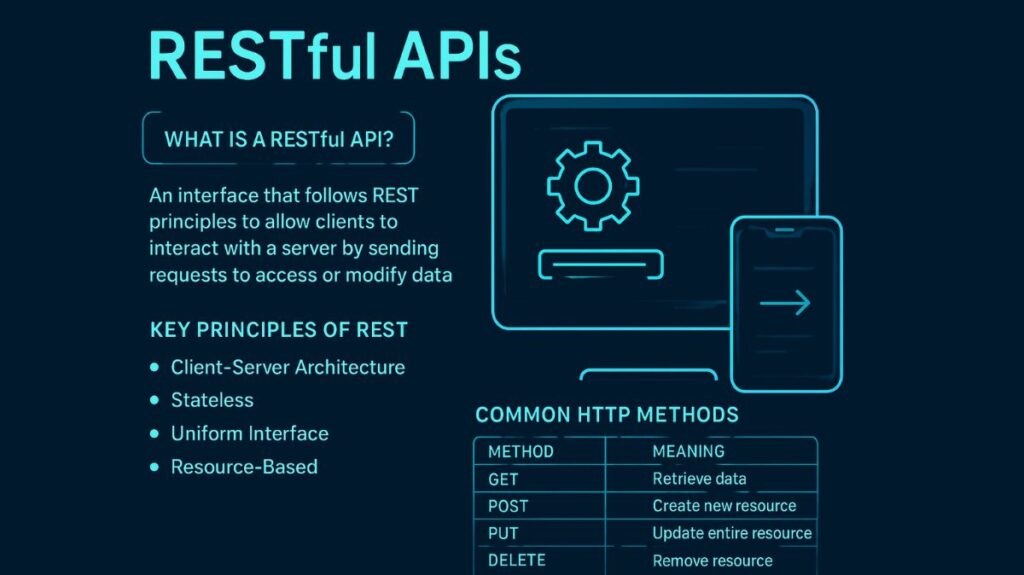
A secure online information exchange between two computer systems is made possible via a REST API (Representational State Transfer Application Programming Interface). REST is an architectural design style or a collection of design principles for developing networked applications, especially web services, rather than a protocol. REST APIs or RESTful APIs are APIs that adhere to the REST architectural style.
The foundational communication technology for data transport over the web is HTTP (Hypertext Transport Protocol), upon which RESTful APIs are based. Systems built using this architectural style are straightforward, very scalable, and simple to integrate.
You can also read IPv4 Subnet Calculator
The REST Communication Model
The main focus of REST APIs is resources, which are any data item (such as a user, network device setting, or document) that can be uniquely identified by a Uniform Resource Identifier (URI), usually a URL.
The communication follows a Client-Server model:
- Client sends Request: Using the proper HTTP method, a client (such as a web browser or mobile application) sends a request to a particular URL or URI. The request could have parameters, headers (metadata), and a body (data).
- Server processes Request: The request is received, validated (including authorization and authentication), and processed by the server.
- Server sends Response: The server sends a response back to the client. This includes an HTTP status code (e.g.,
200 OK,404 Not Found) and a representation of the resource’s state (typically in JSON or XML format) in the response body.
You can also read What is RESTCONF, Architecture and RESTCONF vs NETCONF
Core Architectural Constraints of REST
For an API to be considered truly RESTful, it must adhere to a set of architectural constraints:
- Client-Server Architecture: Each component can be developed, maintained, and scaled independently because the client (front end) and server (back end) are entirely independent.
- Statelessness: Scalability depends on this. Since no client-specific session state or context is saved on the server in between requests, every request made by a client to a server must include all the information required by the server to perform it.
- Cacheable: It is necessary to clearly indicate whether a response is cacheable or not. Clients can improve performance by reducing the need for repeated queries by caching replies.
- Uniform Interface: The mode of communication needs to be standardized and constant. This restriction guarantees that messages are self-descriptive, that clients can alter resources using the representations they get, and that resources are recognized by unique URIs.
- Layered System: To improve scalability and security, clients should be unable to tell if they are speaking with the end server directly or through intermediary layers like load balancers or proxies.
- Code on Demand (Optional): By sending executable code to the client, the server can momentarily increase client functionality.
You can also read What is MP BGP Multiprotocol BGP? Components and Benefits
Where REST Is Used
- Mobile apps (Android/iOS)
- Web applications
- IoT devices
- Cloud services (AWS, Azure, Google Cloud)
- Microservices communication
Standard HTTP Methods (CRUD Operations)
REST APIs leverage standard HTTP methods, which map directly to the fundamental CRUD operations (Create, Read, Update, Delete) for managing resources:
| CRUD Operation | HTTP Method | Purpose | Key Details |
|---|---|---|---|
| Read | GET | Retrieves a representation of a resource. | Returns HTTP status 200 (OK) on success. Used, for example, to fetch device inventory data. |
| Create | POST | Submits data to the server to create a new resource. | Returns HTTP status 201 (Created) upon successful creation. POST is neither safe nor idempotent. |
| Update (Replace) | PUT | Updates or completely replaces an existing resource with the content sent in the request body. | Requires sending the entire resource data. Sending the same PUT request multiple times gives the same result (idempotent). |
| Update (Partial) | PATCH | Applies partial modifications to a resource. | Only requires the specific fields that need updating to be sent in the request body. |
| Delete | DELETE | Removes the resource identified by the URI. | Returns HTTP status 200 (OK) on successful deletion. |
You can also read What is Metro Ethernet Network? how does metro ethernet work
Benefits of REST API
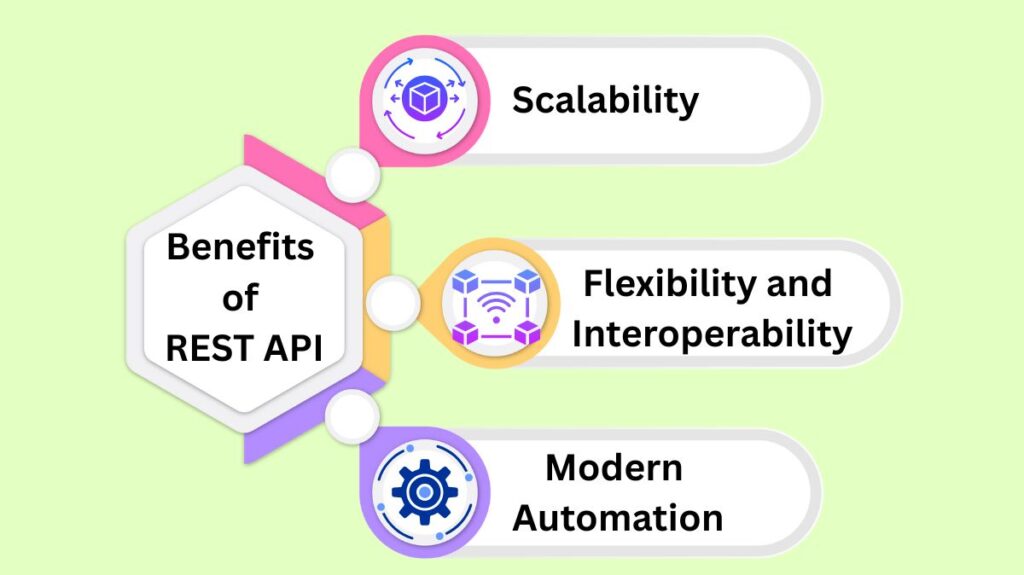
Because of its benefits, REST APIs are the most popular architectural type for contemporary web APIs.
- Scalability: By optimizing client-server interactions through stateless design and cacheability, applications can scale effectively.
- Flexibility and Interoperability: They are platform-agnostic, which means that client and server apps can be created in different languages without compromising communication, and they support a variety of data formats, including JSON.
- Modern Automation: REST APIs are essential for contemporary network automation and management. They replace conventional command-line interfaces (CLIs) by acting as the Northbound Interface (NBI) on Software-Defined Networking (SDN) controllers, enabling programs to programmatically manage network resources. E-commerce product inventory management and meteorological data retrieval are two examples.
Imagine ordering a meal from a restaurant menu to get an idea of how a REST API works. The API is the standardized menu and the waiter (HTTP protocol), the client is the customer, and the server is the kitchen. You utilize a specific command that is aimed at a specific resource (the kitchen/inventory URI) (GET for browsing the menu, POST for making a new order). The kitchen doesn’t have to recall what you ordered last week (statelessness), and you get a structured response (your meal/data representation) combined with a status update (the check/status code).
You can also read What is Message Switching & advantages of message switching