

What is Circuit Switching
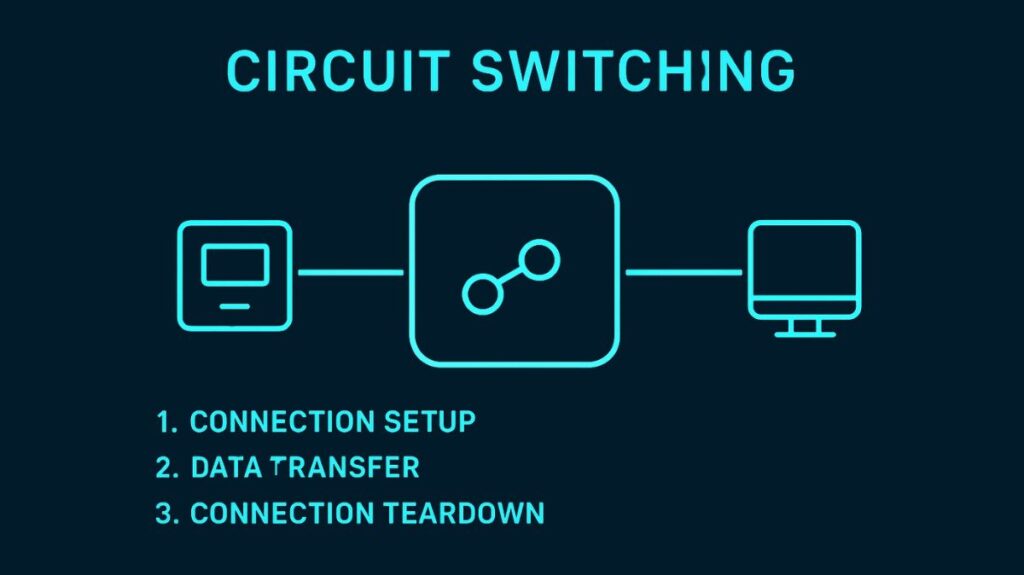
Before any data transmission can start, a dedicated communication channel (or circuit) must be established between the transmitter (source) and the recipient (destination). This technique is known as circuit switching. It is a connection-oriented service because of this strategy.
For the length of the communication session, this specific circuit is kept in reserve and functions as though an electrical connection were physically connecting the two nodes.
You can also read Advantages and Disadvantages of Mesh Topology Network
Characteristics of Circuit Switching
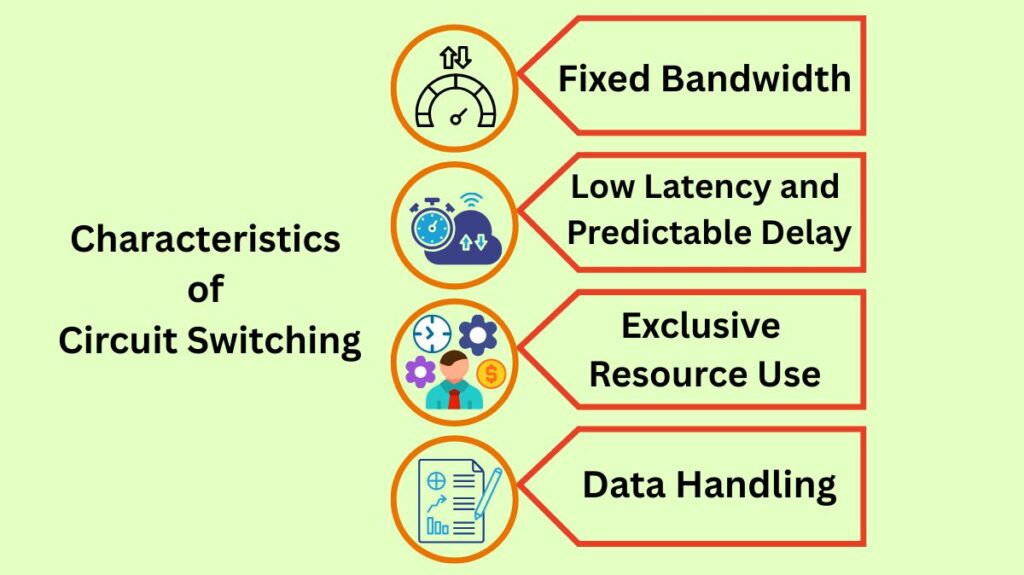
The defining features of circuit switching arise from this dedicated path:
- Fixed Bandwidth: Because resources are set aside specifically for the session, the circuit ensures the channel’s entire bandwidth and a steady transmission rate.
- Low Latency and Predictable Delay: Data flows continuously and without delay as soon as the connection is made. Throughout communication, the bit delay doesn’t change, offering consistent performance.
- Exclusive Resource Use: Until the session is over, no other users may use the reserved path. This avoids data loss or corruption and offers a high degree of reliability.
- Data Handling: There is no need for reordering because data is sent as an uninterrupted stream and always arrives at its destination in the right sequence.
Phases of Operation
Circuit switching involves three distinct phases that must occur sequentially for communication to take place:
- Circuit Establishment (Setup Phase):
- A connection request is made by the sender to the recipient.
- A sequence of intermediate switching centers is used to build a continuous circuit.
- The path’s switches set aside the required resources, such as bandwidth.
- To verify the formation of the circuit, the sender and recipient exchange signals known as request and acknowledgement, or ACK.
- This stage frequently necessitates a significant amount of setup time, which could cause communication delays. If a channel that has been requested is already occupied, congestion may result.
- Data Transfer:
- Data (speech or other signals) are sent over the designated path between the source and destination once the circuit has been successfully formed.
- For the duration of the conversation, the link is active. A consistent quality of service (QoS) is ensured by the exclusive allocation of resources.
- There is no header overhead or wait time at any switch during this phase of data transport.
- Circuit Disconnection (Teardown Phase):
- One of the users starts the disconnect or termination signal when communication is finished.
- In order to make room for new connections, all intermediary links and reserved resources between the sender and the recipient are cut off and freed.
You can also read What is Dual Homed Topology Definition and Applications
Types of Circuit Switching
Circuit switching relies on two primary types of mechanisms to facilitate connections:
- Space Division Switches: These switches create physical transmission pathways by using distinct sets of crosspoints (metallic or semiconductor gates) that are managed by a central unit. They are renowned for their tremendous capacity and quickness.
- Time Division Switches (TDS): This method divides connections into segments broadcast at predetermined time slots and uses Time Division Multiplexing (TDM) to route many connections along a common trunk line. TDM, also known as a digital circuit switch, is appropriate for long-distance connections with high data traffic. TDM multiplexes traffic into predetermined time intervals to prevent variable delays.
Another technique is frequency division multiplexing (FDM), which splits the entire bandwidth into non-overlapping frequency bands, each of which simultaneously carries a different signal.
Circuit Switching vs. Packet Switching
Circuit switching is often contrasted with packet switching, which uses shared resources and variable delay, making it highly efficient for network capacity but sacrificing the quality-of-service guarantees provided by circuit switching.
| Aspect | Circuit Switching | Packet Switching (The Internet) |
| Connection | Dedicated path established and reserved before data transfer. | No dedicated path; data is divided into independent packets. |
| Resource Sharing | Exclusive use of bandwidth; reserved resources are wasted during silent periods. | Shared use of bandwidth; resources are dynamically allocated and highly utilized. |
| Latency | Low and constant delay; ideal for real-time voice/video. | Variable delay (latency) due to congestion and routing decisions. |
| Fault Tolerance | Low; if the dedicated path fails, the connection is dropped. | High; packets can be rerouted around failed links. |
| Efficiency | Inefficient use of network capacity. | Highly efficient use of network capacity.10 |
You can also read What is Point To Multipoint Topology Advantages, Common Uses
Advantages of Circuit Switching
- Guaranteed data rate: Consistent transmission speed is ensured by a dedicated channel.
- No delay in data flow: Continuous data transport is made possible by a dedicated path.
- High reliability: A reserved path guards against corrupted or lost data.
- Quality of service (QoS): Prioritizing important traffic, such as audio or video, is supported by quality of service (QoS).
Disadvantages of Circuit Switching
- Limited scalability: Requires a dedicated path for every communication; unsuitable for big networks.
- Vulnerable to failures: Communication is hampered if a path fails.
- Limited flexibility: Until communication ceases, others cannot utilize dedicated circuits.
- Wastes resources: Resources are wasted because bandwidth is set aside even when no data is transmitted.
- High cost: It is costly to set up and maintain dedicated pathways.
Circuit switching might be compared to booking a dedicated, private lane on a highway for the duration of your journey. No one else can use that lane once it is reserved for you, ensuring that you have a clean road and a set speed whether you are travelling quickly, slowly, or stopped to rest. You pay for the reservation time, though, and your trip is stopped if the reserved lane fails.
You can also read Types of WAN Topologies: Bus, Ring, Star, Mesh, and Hybrid