

Kubernetes storage is a complex subsystem that manages containers’ transience and provides dependable, permanent data management for modern applications. Filesystems in normal containers are temporary; if a container fails or is destroyed, all data is lost. Due to its extensive API abstractions Volumes, PersistentVolumes (PVs), PersistentVolumeClaims (PVCs), and StorageClasses (SCs), Kubernetes decouples physical storage provisioning from application use.
You can also read What are the Environment Variables in Kubernetes?
Types of Kubernetes Storage
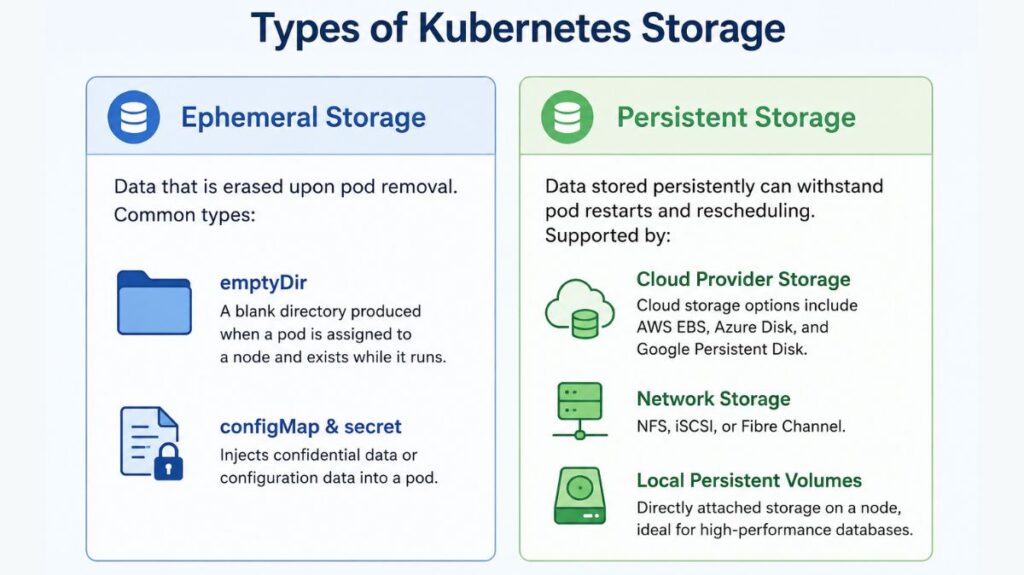
- Ephemeral Storage: Data that is erased upon pod removal. Common types:
emptyDir: A blank directory produced when a pod is assigned to a node and exists while it runs.configMap&secret: Injects confidential data or configuration data into a pod.
- Persistent Storage: Data stored persistently can withstand pod restarts and rescheduling. Supported by:
- Cloud Provider Storage: Cloud storage options include AWS EBS, Azure Disk, and Google Persistent Disk.
- Network Storage: NFS, iSCSI, or Fibre Channel.
- Local Persistent Volumes: Directly attached storage on a node, ideal for high-performance databases.
The Core Concept of Kubernetes Volumes
Volumes, directories accessible to containers in Pods, are the basic storage unit. Volumes’ lifespans are related to their Pods, unlike containers’ filesystems. This means that data survives container crashes but is erased if the Pod is removed.
Kubernetes supports many ephemeral volumes:
- emptyDir: A node’s Pod assignment creates this temporary directory. Although empty, it is often used for scratch space, caching, or data sharing amongst containers in the same Pod.
- hostPath: Mounts a host node filesystem file or directory in the Pod. It connects a Pod to a physical node, preventing portability, but system-level Pods that need to access node internals should use it.
- ConfigMaps and Secrets: These volume types let applications use disk files instead of environment variables for configuration files or sensitive credentials.
You can also read What is Kube-Proxy in Kubernetes and it’s Lifecycle
The Persistent Volume (PV) Subsystem
Kubernetes’ persistent volume subsystem preserves data beyond Pod lifespans. The storage administrator and application developer are clearly separated in this system.
- PersistentVolume (PV): A cluster-wide resource representing network-attached storage is a persistent volume (PV). It exists independently of Pod lifecycles, so data persists after Pod deletion. Administrators can provide PVs manually or dynamically via StorageClass. They support NFS, iSCSI, and cloud-provider-specific solutions like AWS EBS and Google Persistent Disk.
- PersistentVolumeClaim (PVC): A user requests storage with a persistent volume claim (PVC). A PVC utilizes PV resources like a Pod consumes CPU and RAM. Developers specify PVC size, access modes, and storage class. A matching PV is then found and bound to the claim by Kubernetes.
- The Container Storage Interface (CSI): External storage systems are connected to Kubernetes via the industry-standard Container Storage Interface (CSI) plugin layer. Changing core Kubernetes code to integrate data stores was difficult before CSI. CSI’s extensible plugin architecture lets storage vendors like Cloudian and AWS develop drivers “out-of-tree” and release upgrades independently.
Dynamic Provisioning and StorageClasses
Manual PV pre-provisioning is inefficient in large clusters. Dynamic provisioning with StorageClasses (SCs) lets the cluster construct a storage volume when a PVC is requested.
A StorageClass is a “blueprint” for storage tiers like “fast-ssd” and “standard-hdd”. A CSI driver builds an external storage system volume when a PVC mentions a StorageClass. The control plane automatically builds and attaches the PV object to the PVC. Automation greatly cuts administrative costs.
You can also read Kubernetes Controller Manager vs Cloud Controller Manager
Access Modes and Reclaim Policies
Kubernetes administrators can specify volume mounting and management.
- Access Modes: Determine how many nodes can mount a volume.
- ReadWriteOnce (RWO): Node-mounted read-write once (RWO).
- ReadOnlyMany (ROX): Many nodes mount ROX as read-only.
- ReadWriteMany (RWX): Many nodes mount as read-write, usually using NFS.
- ReadWriteOncePod (RWOP): The stricter ReadWriteOncePod (RWOP) option allows only one Pod to mount the disk.
- Reclaim Policies: These determine what happens to the storage asset after a PVC is erased.
- Retain: Administrators can manually restore data from the PV.
- Delete: The PV and storage asset (e.g., AWS EBS volume) are automatically destroyed.
- Recycle: Cleans the volume for reuse with
rm -rf(deprecated in favor of dynamic provisioning).
Storage for Stateful Applications
Databases like PostgreSQL, MySQL, and Redis require more guarantees than stateless apps, which can be managed using conventional Deployments. Kubernetes’ StatefulSet controller handles these duties. StatefulSets maintain network identities and storage bindings unlike Deployments. StatefulSets assign each replica Pod a unique PVC and PV using volume claim templates. If a Pod fails and is rescheduled, the controller reconnects it to its volume to preserve data integrity.
You can also read What is Kubernetes Cloud Controller Manager?
Volume Binding and Performance
Volume binding and dynamic provisioning are controlled by StorageClass Volume Binding Mode.
- Immediate: Binding occurs immediately after PVC creation. This can cause “unschedulable” Pods if the storage is in a zone where scheduling is not possible.
- WaitForFirstConsumer: Binding and provisioning wait until a PVC-using Pod is produced. The scheduler can consider Pod restrictions like node selectors and resource needs before picking a storage structure.
Best Practices and Resource Management
The sources suggest various best practices for cluster stability and cost-efficiency:
- Decoupling: Always include PVCs in container configurations, but never explicitly reference PVs, which strongly ties containers to volumes.
- Defaulting: Setting a default StorageClass prevents PVCs without a class from failing.
- Resource Quotas: Limit storage allocated in a namespace to prevent teams from exhausting the cluster’s budget or capacity.
- Limits and Requests: Limit ephemeral storage resources to prevent containers from filling their host node disk space.
Kubernetes turns containers into a production-ready platform for large, data-intensive corporate workloads by using these abstractions.
You can also read What is a Kubernetes Controller Manager?