

Kubernetes Controller Manager
The basic control loops included with Kubernetes are embedded into a daemon called the Kubernetes controller manager. A control loop is a non-terminating loop used in robotics and automation applications that governs the system’s state. Controllers in Kubernetes monitor the cluster’s shared state via the apiserver and make modifications to bring it toward the desired state. Today’s Kubernetes controllers include replication, endpoints, namespace, and serviceaccounts.
kube-controller-manager [flags]
You can also read Kind: A Practical Guide to Local Kubernetes Clusters
Key Functions
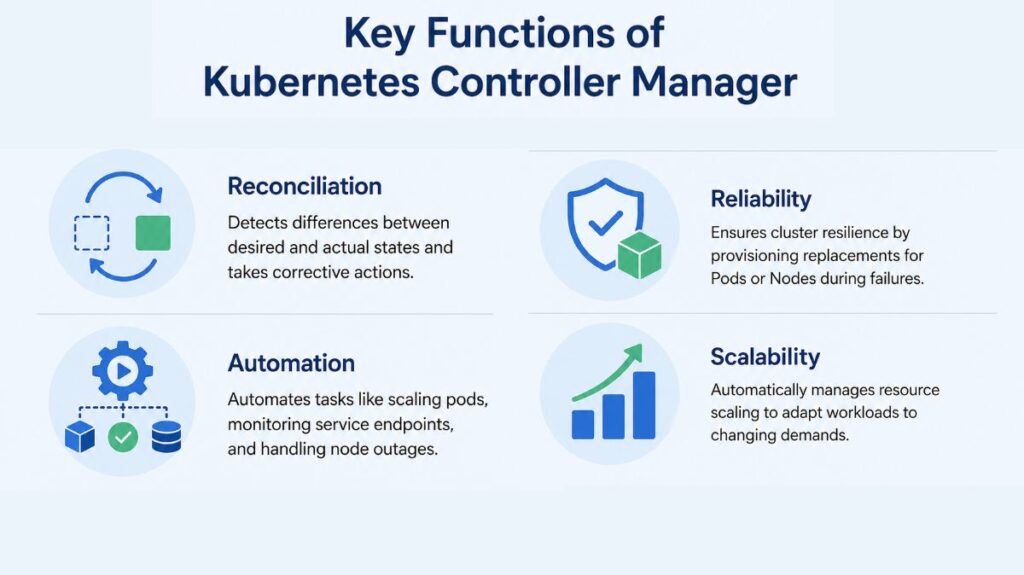
For a Kubernetes cluster to remain automated and retain its operational integrity, the controller manager is necessary. Its primary purposes are as follows:
- Reconciliation: Achieving reconciliation involves conducting control loops to identify disparities between existing and intended states and implementing remedial actions.
- Automation: Automate activities like scaling pods, monitoring service endpoints, and handling node outages to reduce operator interaction.
- Reliability: Ensure cluster resilience by provisioning replacements for Pods or Nodes during failures.
- Scalability: Enables workloads to adjust to shifting needs by automatically managing resource scaling.
You can also read How to Get Started Kubernetes? Explained Briefly
Core Mechanism: The Reconciliation Loop
Reconciliation is the main duty of the Controller Manager. This ongoing process consists of:
- Monitoring: By making requests to the API Server, the manager keeps an eye on the cluster’s present (observed) state.
- Comparison: It finds differences between the desired state specified by the user and the observed state as expressed in YAML manifests.
- Corrective Action: The manager automatically creates a replacement pod if a pod fails to maintain the replica count.
Internal Architecture
The Controller Manager makes use of particular implementation components to function effectively:
- Informers and SharedInformers: Controllers utilize Informers to store resource data locally and get alerts (callbacks) when objects are added, changed, or removed rather than continuously polling the API Server. To cut down on memory cost and API server traffic, a SharedInformer builds a single cache that is shared by several controllers.
- Workqueue: A key is added to a Workqueue when a resource changes, and the Workqueue then distributes these events to the appropriate controllers for processing.
- Leader Election: Several Controller Manager instances may run in high-availability installations, but only one of them serves as the active leader to avoid competing activities.
You can also read What is the Importance of Kubernetes & Why Kubernetes?
Components
The principal kube-controller-manager binary incorporates multiple core controllers into one process:
- Node Controller: Statuses nodes that stop communicating as unhealthy or unresponsive.
- Replication/ReplicaSet Controller: The Replication/ReplicaSet Controller consistently runs the number of pod replicas chosen by the user.
- Endpoint Controller: Creates Endpoints objects to connect pods to services.
- Job Controller: Oversees the start and finish of batch jobs.
- Service Account & Token Controllers: For new namespaces, create default service accounts and API access tokens using Service Account & Token Controllers.
- Persistent Volume Controller: Oversees the binding of PVs and PVCs, or persistent volume claims.
You can also read What is Container Orchestration in Kubernetes?
Distinguishing from the Cloud Controller Manager
Kubernetes frequently makes use of an independent Cloud Controller Manager (CCM) in cloud-based systems. The CCM has cloud-specific logic to connect with Cloud Service Providers for managing resources like load balancers, virtual networking routes, and cloud instances, whilst the traditional Controller Manager manages generic cluster activities (such pods and deployments). The core Kubernetes project can maintain its cloud-neutrality with this division.
Monitoring and Maintenance
Monitoring the Controller Manager’s performance and health is regarded as a best practice for ensuring cluster reliability. Prometheus metrics, which may monitor workqueue depth, reconciliation latency, and the rate of queries to the API Server, are usually used for this. Setting resource restrictions (CPU/memory) for the manager and enabling thorough logging to aid in debugging when state mismatches arise are two more operational best practices.
You can also read What is Kubernetes Architecture, Features of K8s
Challenges
- Debugging Issues:
- Because several controllers may interact with the same resources, determining the underlying reason of disparities can be challenging.
- Performance Bottlenecks:
- The Controller Manager’s capacity to swiftly reconcile states may be hampered by a cluster with a lot of resources.
- Custom Controller Management:
- Custom controllers provide flexibility, but growing and maintaining them calls for more knowledge and resources.
What does a Kubernetes Controller do?
A Kubernetes controller is a loop that monitors the cluster’s state and compares it to user-defined YAML states. Reconciling differences requires creating, modifying, or deleting resources. For instance, a Deployment controller automatically replaces failed Pods to keep the set number functioning.